1
previous arrowprevious arrow
next arrownext arrow

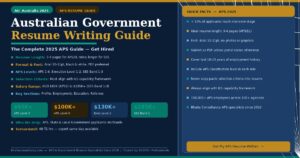
Australian Government Resume Writing

While applying for government work at all levels (Australian Public Service (APS), state or local), writing an effective resume is crucial to the recruitment process. The APS receives thousands of applications for a single role each year for its non-ongoing positions. Only 10% or less of these applicants are interviewed for the role. So having a properly structured resume is essential for success. Your resume is the main source, alongside your answers to selection criteria or in your pitch or detailed cover letter. Which the board will judge your potential fit for the role. To assist applicants to develop their resumes, Bhatia Consultancy Services have developed an Australian Government resume sample and offered some practical tips on how to differentiate yourself in order to increase your chances of being successful.

Australian Government Resume Sample

Government resumes are distinctly different than standard resumes, and they have an exceptionally strict format and style that conform to rigid adherence to application details and standards. In contrast to private sector applications, governmental jobs, particularly in the Australian Public Service (APS), expects applicants to closely follow selection criteria, capability frameworks, and job specific competencies.

Our team of specialist government resume writers has years of experience creating documents that fit the Australian resume framework. While adhering to the APS, state, and local government expectations for document preparation. Based on this experience, we have combined some practical hints and tips to help you ensure your resume fits all requirements and positions you well as a candidate for jobs with government.

Navigating the APS Job Market

The APS is changing. Although the APS is relatively more stable than what’s being experienced in the private sector, that stability does not equate with no change. We see sustained momentum pushing towards a digital transformation, a constant focus on delivering frank and fearless citizen-centric services. And growing need for roles in cybersecurity, data analysis and policy design for a modern Australia.

AI will have an impact – but not as it’s being touted to do so. While AI is very real. It is often viewed as a pervading and all encompassing replacement of workers, whereas what AI is primarily likely to be is an equal collaborator. Given that there are now more automated systems used to sift applications than there are human beings, your resume now needs to be built to communicate effectively with both the machine and the human. The problem is to articulate your unique value proposition clearly to both.

Where the Opportunities Are: APS Roles in Demand Right Now?

Governments require so many varied skills and capabilities. In addition to the traditional policy and administration roles, there is a growing emphasis on demand for:

Cyber Security Specialists: Protecting citizen data and infrastructure is critical.

Data Scientists & Analysts: Turning mountains of public data into the evidence base for policy.

User Researchers & Service Designers: Helping to ensure the government digital services (like myGov) are simple and usable by all Australians.

Project & Program Managers: Leading large infrastructure and digital transformation projects.

Communications & Engagement Officers: Establishing trust and communicating complex government agendas with the public.

What Does The Pay Packet Look Like? 2025 APS Salary Snapshot

APS salaries are very transparent and range between classifications – APS Level (1-6), Executive Level (1-2), and the Senior Executive Service (SES). Here is an approximation for full-time positions (not including super):

Title (level)                                   Average Salary
Admin Officer (APS 3-4)             $65,000 – $75,000
Policy Officer (APS 5-6)              $80,000 – $100,000
IT Specialist (EL 1)                       $110,000 – $125,000
Project Manager (EL 2)               $130,000 – $150,000

APS vs State and Local Government Resumes

When applying for government jobs in Australia, it’s important to understand resumes for the Australian Public Service (APS) are different to those of state and local government.

The APS has more than 150,000 employees in over 100 agencies. And they are very specific about expectations for resumes, including presentation, style, content and alignment with the Integrated Leadership System (ILS) and other capability frameworks. State and local government employers place less strictness on resumes and typically will accept a shorter (and perhaps slightly differently presented) version.

Therefore, its imperative to research the agency/department you applying for, and tailor your application in accordance with their expectations. Which will increase your likelihood of progress in the recruitment process. It may be worth your while to work with a professional government resume writer, particularly one with appropriate APS, state, and local experience in understanding the distinctions so that you can be confident that your application is meeting the specific role requirements.

Following the APS Resume Guidelines

If you are combating a role with the APS it is important to follow the resume guidelines closely. The resume needs to be consistent with the information you provided in your selection criteria responses or your pitch document; everything you provide is considered one package. Therefore all information needs to be consistent, correct and presented appropriately.

For instance, if in your selection criteria you write: “As an Executive Assistant, I led a…”— your resume needs to also reflect this title, employer and employment dates as an Executive Assistant. Consistency and credibly count. Attention to detail is very important to APS recruiters.

Make sure:

  • Job title and employment dates match exactly if you cite them.
  • The key responsibility statements and achievements are also matched to the capability you are addressing.
  • Never use the same statements, meld your resume or selection criteria together, and use both to pitch you differently.

When you properly tailor your resume to the APS standard – or modify it to state and local government standards – you are demonstrating professionalism, accuracy and a clear understanding of the application process, and it will make a difference to you competing in a crowded field.

What Makes Government Resumes Different?

There is more than just length and format that sets government resumes apart from resumes used in the private sector. Unlike some industries that expect to receive resumes limited to 1–2 pages, government resumes often range from 2–6 pages depending on the job and responsibilities. There are no strict rules about length; simply refer to the relevant application guide as many panels may set a page limit.

Following instructions is crucial, as failure to do so is one of the most common reasons candidates are no longer considered for a position. With APS, state, and other public sector jobs receiving thousands of applications and applicants each year, your chances of progressing to the next step can be decreased by even careless errors.

For style, government resumes are deliberately simple and professional. Panels prefer clear layouts, “boring” fonts (such as Arial) in black and white (10-11 pt), and do not use photos and graphics, or managed, pretty, layouts that could distract from a reader, or may not pass an automated system.

The focus is on clarity, accuracy and alignment to selection criteria, and NOT style to make sure that your skills and experience are considered solely on the merits.

How To Write A Resumé For Australian Government Jobs?

A good Australian government resumé should clearly outline your skills, experience and qualifications in a logical, professional structure. Typical sections include Personal Details, Education, Employment Experience, Volunteer Experience, and Referees. Use a simple font that is easy to read such as Arial 10-11 pt, with a basic plain black-and-white template for maximum readability.

Personal Details

Your full name, phone number, email address, and LinkedIn profile (if you have one). It is good practice to include a summary job title that describes both your career history and the role you are applying for, for example, Administration Professional or Customer Service Specialist; you are directly signalling your professional role to the panel.

Education

Provide information regarding all relevant qualifications and education including degrees, certificates, and professional training. You may exclude dated or irrelevant qualifications if it would not enhance your application. Most Australian government positions require demonstrated education competencies therefore you must include any certificates that are relevant to the position.

Australia’s Leading Government Resume Writers

Employment Experience and Achievements

Identify your employment experience in chronological order. Include job titles, employers, dates of employment, and if there are any employment gaps briefly and professionally explain those gaps.

Highlight achievements and accomplishments, with an emphasis on the employment experience that is relevant to the position. For example, if you are applying for an administrative position that involves payroll you should include any previous experiences with payroll.

In addition, if applicable identify your government entitlement levels (APS3, or higher) and include any acting or unsolicited higher duties. Typically, panels that are reviewing APS applications will refer to the information that you are providing to help them assess your suitability and capability against the requirements of the position.

Volunteer Work or Other Relevant Experience

It is a good idea to include volunteer work or community involvement that demonstrates transferable skills. For example, being a treasurer of a local sports club demonstrates administrative and financial management experience. These experiences may support your application for a government job in administration.

Referees

List two referees including their name, title, organization and contact information. Always check with your referees that they are willing to discuss your performance in a professional context prior to adding them to your referees. Recruiters in the Australian government like referees who can confirm the skills and experience you have listed as part of your application, this will weight a candidate’s application in their favor.

What to Exclude from Your Government Resume?

When creating a government resume, you should focus on relevant information that’s related to the role and that demonstrates your competencies. Additional personal details and unrelated information may take away from the rest of your application and may also, in contravention to anti-discrimination principles, elicit discrimination. The key items to eliminate are:

Date of birth, marital status, or gender – Australian government employers assess you on their merits. While an assortment of experience, qualifications, skills, and personal attributes are assessed, these details are not required.

Irrelevant reasons for leaving positions – Context is warranted only as it dovetails into your suitability or a continuity of employment decision.

Irrelevant hobbies and interests – While Panels seek relevant skills, experience, and achievements and will consider everything included in your resume, they will not see these and do not seek those informal bits and pieces remotely, pertaining to the role. Hobbies should only be labelled as such if those hobbies demonstrate skills transferable in the role.

Photographs – In most industries, unless you take out a paid advertisement or some such, the inclusion of many aspects that may be permitted in the private sector are as a whole, not appropriate for government resumes (e.g., photographs, graphics, and embellishment).

If your government resume is solely relevant, factual, and measurable, your chances of going forward in a highly competitive application process (one in which, for example, some APS and state government roles can receive hundreds (in stressful cases, thousands) of applicants and on occasions, for a single role) will improve.

Australian Government Sample Resume | How to Write an APS Resume That Gets You Noticed?

JESSICA SMITH
Senior Administration Professional
PH: 0412 345 678 | E: [email protected]
A: 25 Government Avenue, Canberra, ACT
LinkedIn: linkedin.com/in/jessica-smith

PROFILE & KEY SKILLS

Outstanding Communication Skills: As Senior Administrative Officer, led the team’s adaptation to Machinery of Government changes, communicating updates clearly both verbally and in writing, ensuring smooth implementation with minimal disruption.

Attention to Detail: Managed complex travel itineraries for senior executives, coordinating flights, accommodation, ground transport, and multi-destination trips seamlessly.

Policy and Procedure Compliance: Implemented a new data privacy policy as an Executive Assistant, ensuring adherence to updated regulations. Reviewed, communicated, and trained staff effectively, guaranteeing compliance across all relevant departments.

EMPLOYMENT HISTORY

November 2016 – Present
Executive Assistant | Department of XYZ

Key Achievements:

  • Ensured safety compliance on a project with a large number of non-English (Mandarin) speaking employees by translating SWMS documents and facilitating on-site interpreter-led training.

  • [Additional Achievement 2]

Duties:

  • Provide comprehensive administrative support to a senior executive.

  • [Duty 2]

Expert Government Resume Writers

November 2014 – October 2016
Job Title | Organisation

Key Achievements:

  • [Achievement 1]

  • [Achievement 2]

Duties:

  • [Duty 1]

  • [Duty 2]

November 2010 – October 2014
Job Title | Organisation

Key Achievements:

  • [Achievement 1]

  • [Achievement 2]

Duties:

  • [Duty 1]

  • [Duty 2]

EDUCATION

Diploma in Quality Auditing | ABC Training Institute | 2019

VOLUNTEER / OTHER RELEVANT EXPERIENCE

Treasurer | Canberra Golf Club (2019 – Present)
Managed the club’s budget, oversaw income and expenses, and ensured accurate, up-to-date financial records.

REFEREES

Sally Thompson | Administration Manager | Department of XYZ | [email protected] | 0411 234 567
Michael Lee | Senior Executive | Organisation ABC | [email protected] | 0412 345 890

FAQs: Australian Government Resume Samples & Advice

Q1: Can I see an example of an Australian Government resume?

While professional writers have long-standing privacy implications not allowing them to typically show full, actual client examples, we can provide a dramatically redacted templates or outlines that represents layout, language, and formatting that would be indicative of relevant resumes. The main elements to be looking for are on the documents: clear headings, bullet points formatting, measurable achievements, and the inclusion of key APS capabilities and keywords. I would be happy to provide a structured template that would represent these tenets – just reach out.

Australian Government Resume Sample

Q2: How long should my public service resume be?

In most APS and EL level roles, the current magic number is 3-4 pages long. It allows enough space to present relevant experience and achievements without overwhelming the reader. SES applications may prove longer due to experience distribution, breadth of experience needed, etc. The golden rule in this event is relevance and not length.

Q3: What’s the difference between a resume and a CV for government jobs?

In the Australian labour context, they are essentially the same document, however, you would often have to submit a “CV” when applying for technical, scientific or research focused roles (i.e. CSIRO, DFAT etc). This version may vary in length due to possible additional publications, conferences and project accumulation. In most generalist APS roles, CV and resume are oftentimes interchangeable.

Australian Government Resume Sample

Q4: How important is it to respond to the selection criteria?

Very important. This is the one, most unique aspect of an Australian Government application. Your resume must work in conjunction with your pitch/statement in fact, against the selection criteria. A great way to develop your resume is to blend specific evidence to key capabilities (i.e “achieves results,” “communicates with influence”) within the achievements in the resume so the resume reinforces your pitch.

Q5: Do I mention referees on my resume?

Best practice is to simply state “Referees: Available on request” at the end of your document. This saves space and allows you to give your referees notice. When a particular potential employer is going to be in touch with them. Have a separate document with two or three referees (including their name, title, organisation, phone and email) on standby. That is ready to send immediately if requested.

Australian Government Resume Sample

Q6: What is the best format to save my resume in for an online application?

Always follow the instructions on the application portal. If there is no preference, PDF is usually the safest option. This way your wonderful formatting will remain intact in a variety of devices and operating systems. An ATS can read it correctly and a hiring manager will see what you wanted them to see. Definitely don’t use a Word document if you have added any complex formatting. Because it will always look messy on another screen.

Q7: What is the optimal length of time to go back in my work history?

A good guideline would be to consider only the last 10-15 years of your career, documenting it in detail. Anything beyond, you can summarize in a brief “Early Career” section simply listing the title, organization, and appointment dates. This way, you remain focused on your most relevant and current achievements. Unless the earlier position is critical to job you’re applying for.

Australian Government Resume Sample

Australian Government Resume Sample

Australia No 1 Professional Resume Writing Services | Australia’s Best CV Writers

Our expert CV and resume writing services in Australia are tailored for individuals aiming to stand out in today’s competitive job market. Resume CV Writers in Australia collaborate exclusively with highly skilled and rigorously vetted professional resume writers from across Australia. Each writer brings extensive expertise in crafting compelling resumes, tailored cover letters, executive bios, and detailed selection criteria documents for both public and private sector roles.

Jobs in Australias Top Cities | CV Writing Services Australia | Resume for Australia

With an in-depth understanding of evolving recruitment trends and employer expectations, our writers work one-on-one with clients to deliver strategically written, results-oriented applications. To date, we have successfully created and optimized over 10,000 job application documents for clients across major Australian cities—including Sydney, Melbourne, Brisbane, Perth, Adelaide, and Canberra—as well as regional centers.

Hire the best Resume Writers in Australia | Resume Crafting Services in Australia | Professional Resume Services Australia

In addition to our Australia-focused services, we specialize in country-specific CV and resume formats to meet international standards. Our global clientele spans 30+ countries, enabling us to deliver documents that align with market-specific requirements and Applicant Tracking Systems (ATS) across industries.

Why Resume Writing Still Matters in 2025?

Imagine it: You are scrolling through SEEK, your heart thumping as an opportunity of your dreams presents itself. After uploading your resume and clicking submit, you hear nothing but crickets. Sound familiar? The Australian job market for 2025 rings cutthroat, with hundreds entering for each opening. But here is the kicker-resumes are not dead. They are just smarter, sharper, and more strategic.

A resume is no longer about listing jobs; instead, it is your own pitch to a hiring manager, your first handshake. Done correctly, it opens doors; done poorly, it ends up lost in cyberspace. In this guide, I will go over why expensive resume writing services in Australia are worth their price, deconstruct the job market, illuminate in-demand roles, unpack salary trends, and teach you how to stay ahead while AI and automation rewrite the rulebook. Ready to make your next career move count? Let’s begin.

Understanding the Australia Job Market in 2025

Australia has a highly diversified job market in 2025, being an arena of opportunities and challenges. As employment rates hovered around 4.0%, top jobs attracted high competition with some receiving over 500 applications. Tech giants have shrunk, with drastic layoffs being felt by software developers and marketers. In contrast, skilled trades, healthcare, and green energy are growing strong under government investments into sustainability and aging populations.

Remote and hybrid are here to stay. With nearly half of Australian professionals expecting flexible arrangements, employers are dangling this carrot for attracting top talent. AI and automation are shaking these arrangements up, too. As routines are disrupted, roles need data literacies, problems solving, and emotional intelligence. For a job seeker, the only thing that means is: Adaptability is non-negotiable.

Top In-Demand Jobs in Australia Right Now | High Demand Occupations in Australia

Wondering where the action is? Here’s a rundown of industries and roles employers can’t fill fast enough in 2025:

  • Registered Nurse: With an aging population, hospitals and community clinics are desperate for nurses. Average salary: $78,405.
  • Data Analyst: Companies are drowning in data and need pros to make sense of it. Think retail, finance, and tech.
  • Cybersecurity Specialist: As cyber threats soar, businesses are investing heavily in protection.
  • Renewable Energy Technician: Solar and wind projects are creating thousands of jobs in regional areas.
  • Construction Project Manager: Infrastructure spending is driving demand for skilled managers.
  • Aged Care Worker: A growing sector with roles ranging from carers to coordinators.

These fields aren’t just hot now—they’re built to last. But landing these jobs means your resume needs to speak the language of the industry, not just list your experience.

Future-Proof Careers: Where the Jobs Are Heading

What’s next? By 2030, Australia’s workforce is projected to grow by nearly 2 million, with tech, healthcare, and sustainability leading the charge. Roles like AI ethicists, telehealth specialists, and carbon reduction consultants are emerging as businesses pivot to greener, smarter operations.

Planning ahead? Here’s where the action is moving:

  • AI and Machine Learning Specialists
  • Renewable Energy Engineers
  • Mental Health Professionals
  • UX/UI Designers
  • Diversity & Inclusion Managers

The most in-demand skills? Think beyond hard tech: data literacy, emotional intelligence, digital communication, change management, and the ability to work with AI, not against it. Reskilling and upskilling aren’t optional anymore—they’re your ticket to staying relevant.

Australia Salary Trends in 2025: What Are People Earning?

Let’s talk money. Salaries in 2025 vary widely by industry and location. Here’s a snapshot of popular roles:

Job Title

Average Salary Range (AUD)

Registered Nurse

$70,000–$85,000

Data Analyst

$80,000–$110,000

Cybersecurity Specialist

$100,000–$140,000

Renewable Energy Technician

$65,000–$90,000

Construction Project Manager

$120,000–$160,000

Aged Care Worker

$50,000–$70,000

Source: Adapted from Adecco and Aquent Salary Guides 2025

Sydney and Melbourne command higher pay, but regional roles in mining and renewables often come with hefty bonuses. Flexibility is a big perk too—think hybrid work, extra leave, or childcare subsidies. One client, James, negotiated a 10% salary bump and remote work days because his resume highlighted his ability to manage teams virtually. A strong resume doesn’t just get you hired; it sets you up to negotiate better terms.

What Makes Australian Resumes Unique? Key Differences and Best Practices | Australias Best Resume Writing Service

While Australian and U.S. resumes share several similarities, there are distinct nuances that international job seekers must understand to align with Australian hiring standards. Here’s what sets an Australian resume apart:

Terminology: Resume vs CV

In Australia, the terms “resume” and “CV” (curriculum vitae) are often used interchangeably. However, “resume” is the more commonly accepted term in everyday use and job applications.

This contrasts with:

  • The United States, where resumes and CVs serve distinct purposes (resumes are concise and job-focused; CVs are academic and lengthy),

  • Europe, where the term “CV” is standard and typically follows the Europass format.

For job applications in Australia, always use the term “resume” unless applying for an academic or research position.

Best Resume Writing Services in Australia | Best Resume Writing Specialists in Wollongong New South Wales

Length: More Comprehensive Than U.S. Resumes

Australian resumes tend to be 2–3 pages in length, depending on your level of experience. This contrasts with the U.S. market, where 1–2 pages is the norm.

Recommended Length Guidelines:

  • Entry-level professionals: 1–2 pages

  • Mid-level candidates: 2 pages

  • Senior professionals / executives: 2–3 pages

Australian employers appreciate detailed role descriptions, achievements, and quantifiable results, provided they are relevant. As a general rule, limit your employment history to the past 10–15 years, unless earlier roles are directly relevant to the position.

Leading Resume and CV Writers in Sydney New South Wales | Top Resume Writers in Adelaide South Australia

Language and Dialect: Use Australian English

To reflect professionalism and cultural alignment, ensure your resume adheres to Australian English spelling and vocabulary.

Key Variations:

American English Australian English
Color Colour
Center Centre
Realize Realise
Elevator Lift
Apartment Flat
Gasoline Petrol

Units of Measurement should also follow local norms:

  • Miles → Kilometres

  • Pounds → Kilograms

  • Quarts → Litres

Consistency in spelling and terminology demonstrates attention to detail and cultural adaptability — traits highly valued by Australian employers.

Australian Resume Formatting Tips: Best Practices for a Professional, ATS-Friendly Resume

While the overall structure of Australian resumes closely resembles that of their U.S. counterparts, attention to detail in formatting can significantly enhance both readability and compatibility with applicant tracking systems (ATS). Below are expert-backed formatting guidelines tailored for the Australian job market:

Use a Clean, Professional Font

According to the Australian Government Department of Employment and Workplace Relations, recommended fonts include:

  • Calibri

  • Arial

Use a standard font size of 11 points for optimal readability. These fonts are widely recognized for their clarity, simplicity, and ATS-compatibility.

Maintain Consistent Margins

Set uniform 1-inch (2.54 cm) margins on all sides of your document. This ensures a clean, professional layout.

  • If additional space is needed, you may reduce the margins slightly, but never go below 0.5 inches (1.27 cm) to maintain document structure and legibility.

Australia’s Best Resume Writing Service | Top Rated Resume and CV Professionals in Canberra Australia

Optimize Line Spacing for Readability

Utilize single or 1.15 to 1.5 line spacing throughout your resume. Balanced spacing not only improves scan-ability but also enhances the overall visual appeal of your resume, making it easier for both hiring managers and ATS to parse.

Avoid Complex Elements That Disrupt ATS

To ensure full compatibility with Applicant Tracking Systems (ATS), avoid using:

  • Tables

  • Graphics

  • Icons

  • Images

These elements may prevent your resume from being accurately parsed by recruitment software, which can lead to automatic disqualification.

Use A4 Paper Size for Printing

In Australia, the standard resume paper size is A4 (8.27” x 11.69”), not U.S. letter size. If you intend to submit a hard copy or upload a PDF, make sure your file is optimized for A4 dimensions to maintain formatting consistency.

Why Professional Resume Writing Services in Australia Make a Difference? | Resumes for the Australian Job Market

Ever read your resume and think, “This doesn’t sound like me?” A pro writer helps articulate your strengths in a way that resonates with employers.

Real-Life Example:

Sarah, a mid-level project manager, struggled to land interviews. After working with a resume writer, her revamped resume highlighted leadership in key projects—result? Three interviews in two weeks.

Professional services offer:
✔ Industry-specific expertise (they know what hiring managers want).
✔ ATS optimization (so your resume gets seen).
✔ Confidence boost (a polished resume makes you a stronger negotiator).

Australia’s No.1 Resume Writer | Best Resume Writing Services in Australia | Frequently Asked Questions Faqs for Australian Resume

Bhatia Consultancy Services engages Australia’s top-tier, resume writers with proven expertise across diverse sectors and professional levels. Our writers possess a deep understanding of Australian recruitment standards and have successfully supported thousands of clients—from entry-level professionals to senior executives—by crafting tailored, results-oriented resumes that meet industry expectations and pass ATS screening systems.”

Frequently Asked Questions FAQs For Australian Resume Standards and Best Practices

1. What is the preferred resume format in Australia?

The reverse-chronological resume format is the most widely accepted and recommended format across Australia. This structure emphasizes your professional work history, starting with your most recent role and moving backward. It effectively showcases career growth, achievements, and role progression over time.

Moreover, this format is ATS-friendly (Applicant Tracking System) and allows hiring managers to quickly scan qualifications and work experience, making it ideal for the majority of job applications.

2. Do Australians use “CV” or “resume”?

In Australia, both terms—“CV” (Curriculum Vitae) and “resume”—are used interchangeably. However, the term “resume” is more commonly used for general job applications in most industries.

A “CV” is typically reserved for academic, research, or medical positions, where a more comprehensive overview of qualifications and professional contributions is required. For such roles, we recommend using our custom CV creation service, which follows industry-specific standards and expectations.

Resume CV Writers in Australia | Australias Best Resume Writers | Elite CV and Resume Writing Services in Melbourne Victoria

3. How are references listed on an Australian resume?

As per guidelines from reputable institutions like the Australian National University (ANU), employers often prefer speaking with referees—individuals who can attest to your professional competencies and character.

There are two widely accepted practices:

  • Include a dedicated “Referees” section listing 2–3 references with their name, title, company, phone number, and email.

  • Alternatively, include the phrase: “Referees available upon request.”

Whenever possible, include local Australian references—such as a former manager from a casual or part-time role or a professor from an academic program completed in Australia.

Resume CV Writers in Australia

4. Should I include a photo on my Australian resume?

No. Including a photograph on your resume is not standard practice in Australia and is generally discouraged. Unlike some international markets, Australian employers prioritize skills, experience, and cultural fit, and including a photo may unintentionally introduce bias during the hiring process.

Only include a photo if it is explicitly requested in the job description (e.g., for acting, modeling, or public-facing roles).

Resume CV Writers in Australia | Highly Skilled Resume and CV Writers in Brisbane Queensland | Australias 1 Professional Resume Writing Services

5. What does a professionally formatted resume look like in Australia?

An effective Australian resume should feature:

  • A clear, concise layout (ideally 1–2 pages in length)

  • Consistent formatting, including bold headers and bullet points

  • Readable fonts such as Arial, Calibri, or Times New Roman

  • No unnecessary graphics, images, or excessive color

Resume CV Writers in Australia | Renowned Resume and CV Writers in Newcastle New South Wales

6. How should I write a resume tailored to the Australian job market?

Crafting an effective Australian resume requires adherence to specific formatting and content standards commonly expected by local employers and recruiters. Our expert resume writers follow best practices that emphasize clear, concise language, a targeted career summary, and a well-structured overview of professional experience, education, skills, and achievements. We focus on tailoring each resume to the Australian job market by incorporating industry-relevant terminology, Australian English spelling, and role-specific accomplishments.

Resume CV Writers in Australia | Expert CV and Resume Writers in Hobart Tasmania | Expertly Crafted Resumes and CVs in Perth Western Australia

7. What are the most effective resume formats for the Australian market?

The three most commonly accepted resume formats in Australia are:

  • Reverse-Chronological – Ideal for professionals with a consistent employment history.

  • Functional (Skills-Based) – Best suited for those changing careers or with gaps in employment.

  • Combination (Hybrid) – A balanced approach that highlights both skills and work experience.

The format selection depends on your career stage, industry, and employment history. Our consultants assess your background to recommend the format that maximizes your strengths.

Resume CV Writers in Australia

8. How can I make my resume stand out from other applicants?

To ensure your resume stands out in a competitive job market, we recommend:

  • Integrating job-specific keywords and phrases aligned with the position description.

  • Quantifying achievements using metrics and performance indicators (e.g., “Increased sales by 35% YoY”).

  • Employing a clean, professional layout optimized for Applicant Tracking Systems (ATS).

  • Maintaining consistent formatting and conducting thorough proofreading to eliminate errors.

Resume CV Writers in Australia

9. Is a cover letter necessary when applying for jobs in Australia?

While not always mandatory, a well-crafted cover letter can significantly enhance your job application. It serves as a personal introduction, allowing you to express interest in the role, align your qualifications with the employer’s requirements, and demonstrate enthusiasm. A tailored cover letter often sets applicants apart because it highlights their soft skills and motivations that the resume might overlook.

Resume CV Writers in Australia

Resume CV Writers in Australia