Europass CV Templates & European Resume Samples by Job and Country
Browse 39 ATS-friendly resume examples, 27 by job and 12 in the CV formats of European countries, with JPG previews and text PDFs. Each sample has a different professional design and follows the Europass structure or the local CV rules, from the German Lebenslauf and UK CV to French, Italian, Swiss, Dutch and Nordic formats.
languages to create, store and share a Europass CV
8
EQF levels for comparing qualifications
39
sample CVs, each as JPG and text PDF
12
country CV formats from Germany to Norway
6
CEFR language levels, A1 to C2
2.0%
EU job vacancy rate, Q2 2026
Facts verified against Europass, the European Commission (JRC), the European Labour Authority and published Eurostat figures. Last updated 11 October 2026.
What is a Europass CV?
A Europass CV is the standardised CV format provided by the European Commission’s Europass service, managed by the Directorate-General for Employment, Social Affairs and Inclusion. The Europass site calls it one of the best-known CV formats in Europe, familiar to employers and education institutions. You create a Europass profile covering your education, training, work experience and skills, then generate as many CVs as you need by choosing which profile information to include and a design. CVs can be created, stored and shared in 31 languages, and you can send them to employers, EURES or other job boards.
Europass CV vs ATS: how to pass applicant tracking systems
Most European employers and recruiters use applicant tracking systems (ATS) to parse CVs. These rules keep a Europass-style CV readable by software and by people:
Upload text, not images. A JPG or PNG is an image that an ATS cannot read. Submit a text-based PDF (or the format the vacancy requests) and keep the JPG for previews and sharing.
Use standard headings such as Work experience, Education and training, Personal skills and Languages, in reverse chronological order (most recent first), as Germany’s official portal advises.
Keep the reading order simple. Put your main content first in the file, avoid text inside graphics, and use real text for dates, job titles and employers.
Mirror the vacancy’s keywords truthfully: tools, standards, licences and certificates named in the advert (for example EN ISO 9606-1, Driver CPC, VDE 0100, CEFR levels).
Quantify results with numbers you can defend: volumes, percentages, accuracy rates, savings and safety records.
Europass CV structure: sections to include
The classic Europass layout used by the samples on this page, in recommended order.
Personal information and job applied for. Name, location, phone, professional email, nationality if relevant, and the position you are applying for. Leave out data the employer does not need.
About me (profile). Three to four lines: years of experience, core skills, standards or licences and the kind of role you want.
Work experience. Reverse chronological. Give dates (MM/YYYY), job title, employer, location and business or sector, then achievements with numbers.
Education and training. Qualification, institution, country, dates and the EQF level (1 to 8) so employers in other countries can compare it.
Language skills. State your mother tongue and list other languages by CEFR level (A1 to C2) for listening, reading, spoken interaction, spoken production and writing.
Digital skills. Self-assess against the five DigComp areas: information and data literacy, communication and collaboration, digital content creation, safety and problem solving.
Communication, organisation and job-related skills. Short, evidence-based statements plus the tools, machines, software and standards you work with.
Certifications and registration. Professional registration, licences, mandatory safety certificates and expiry dates where relevant.
Additional information. Driving licence, volunteering, memberships and availability.
CV formats by European country: 12 samples with local rules
Photo, length and personal-data rules differ by country, so one CV does not fit every application. Each sample below follows its country’s conventions, in the local language, with a different design.
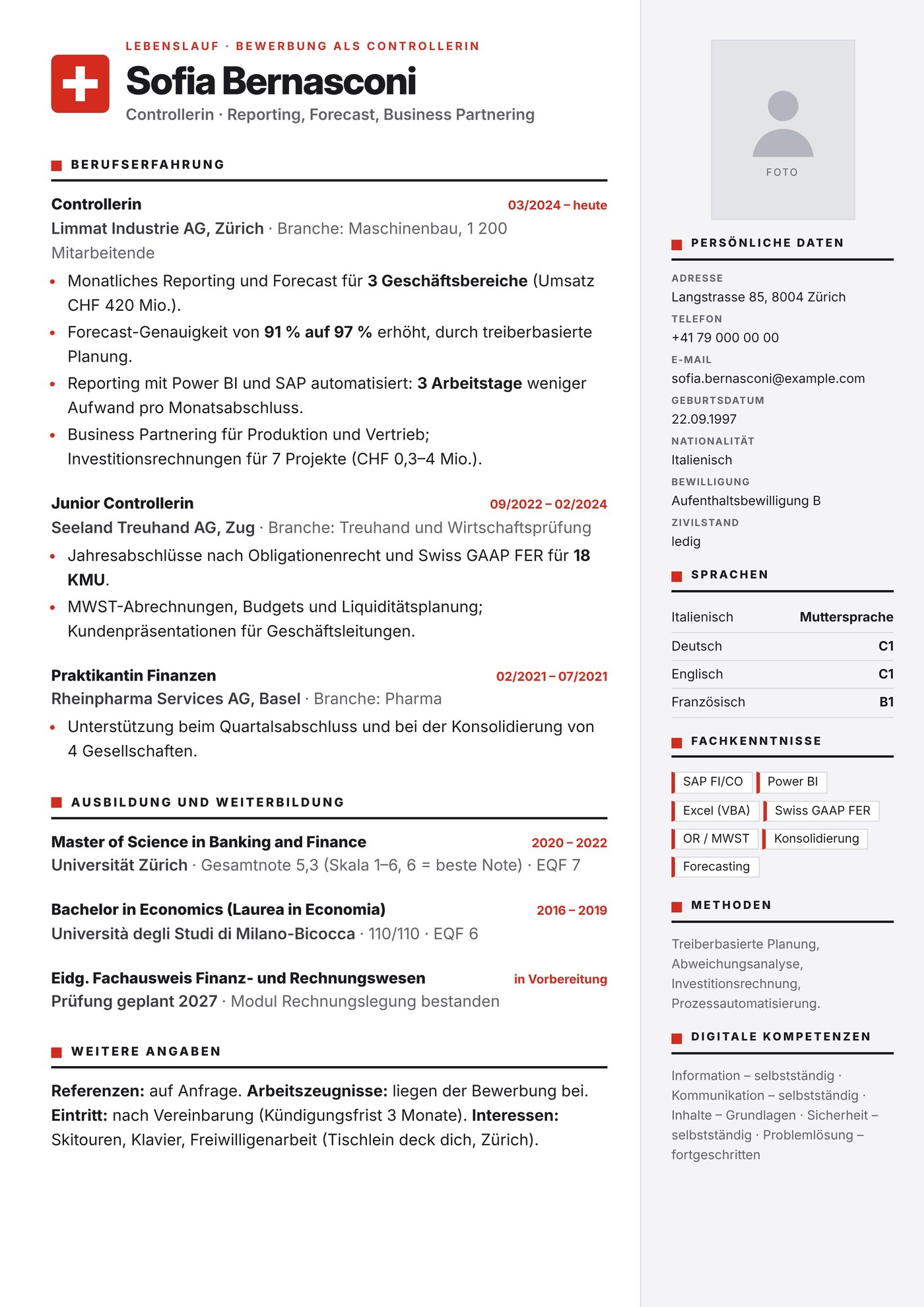
German (Swiss spelling) · Controller, Zurich. Design: White main column with a Swiss-cross mark and a grey right sidebar with photo and personal data.
One to two pages; only people with extensive experience or an academic career may go up to three.
Reverse-chronological order with a simple layout; complex graphics may not be read by applicant tracking systems.
A photo is not legally required but is described as very common and expected in Switzerland; use a professional photo.
More Switzerland CV rules
Birth date is expected; foreign applicants should state nationality and residence permit (B or C); civil status is optional but still common.
Write "Auf Anfrage" for references, attach employer references (Arbeitszeugnisse) to the application, and use "ss" instead of "ß"; Swiss grades run from 1 to 6, with 6 the best.
Save as a PDF with a clear filename such as Lebenslauf_Vorname_Nachname.pdf.
Also searched as: Lebenslauf Schweiz, CV Schweiz Vorlage, Bewerbungsdossier Schweiz
CV format samples for France, Italy, the Netherlands and the United Kingdom
Four large job markets, four different CV habits: a one-page French CV, an Italian CV with a GDPR clause, a short Dutch CV without a photo, and a British CV that omits personal details.
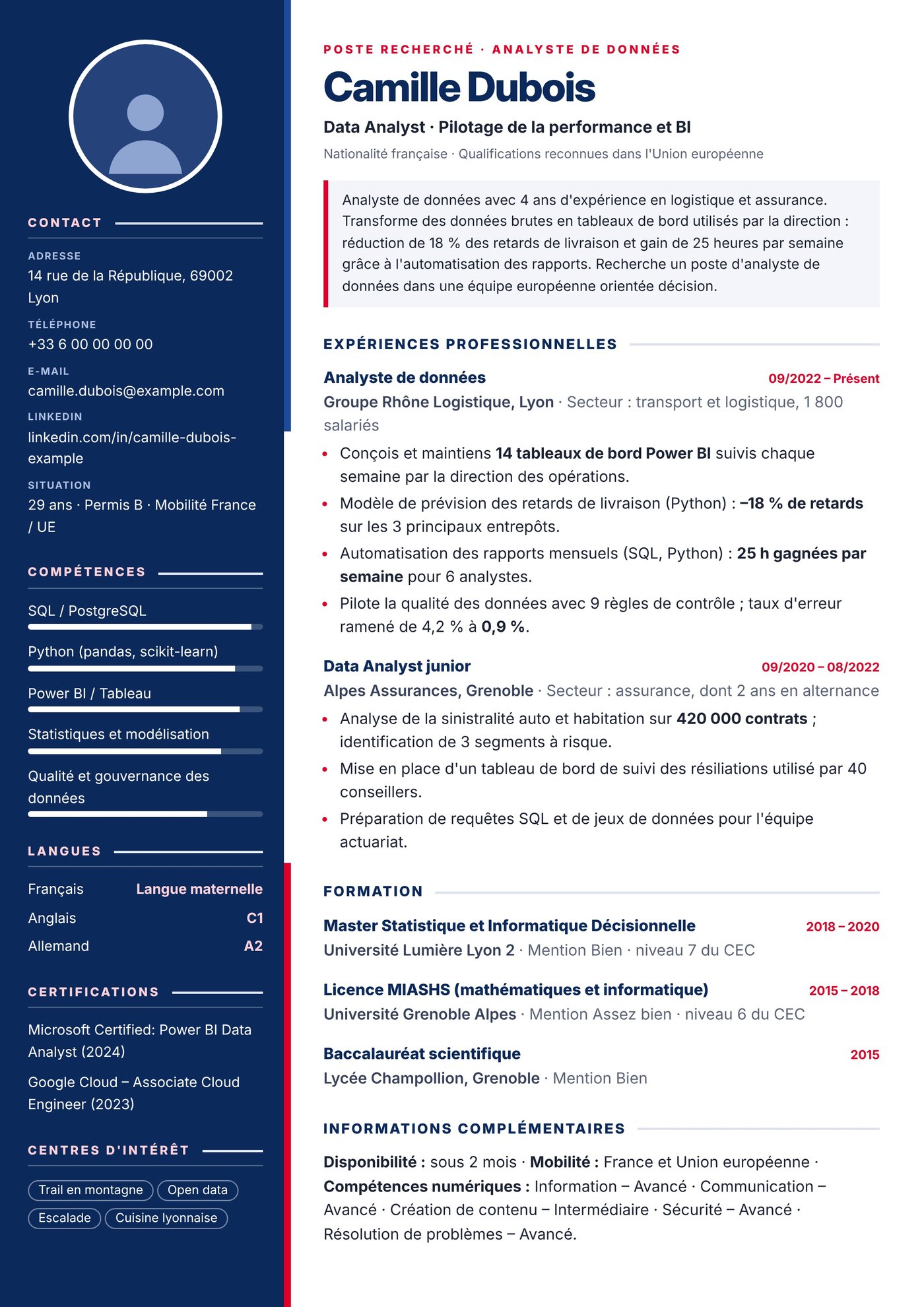
France CV format: CV (curriculum vitæ) (Data Analyst resume example)
French · Data Analyst, Lyon. Design: Dark blue sidebar with a round photo, skill bars and a bleu-blanc-rouge edge.
One page, two at most, on plain white A4 in a classic font.
A photo is optional unless the job advert asks for one; if used, it must be good quality.
Header: full name, address, phone and a professional email; the guide lists age rather than date of birth.
More France CV rules
State the target job title at the top so the recruiter sees it at a glance.
Put skills and work experience (reverse chronological) before education unless you are a beginner; list specific interests rather than vague ones.
Also searched as: modèle de CV, exemple de CV, CV France, CV en français
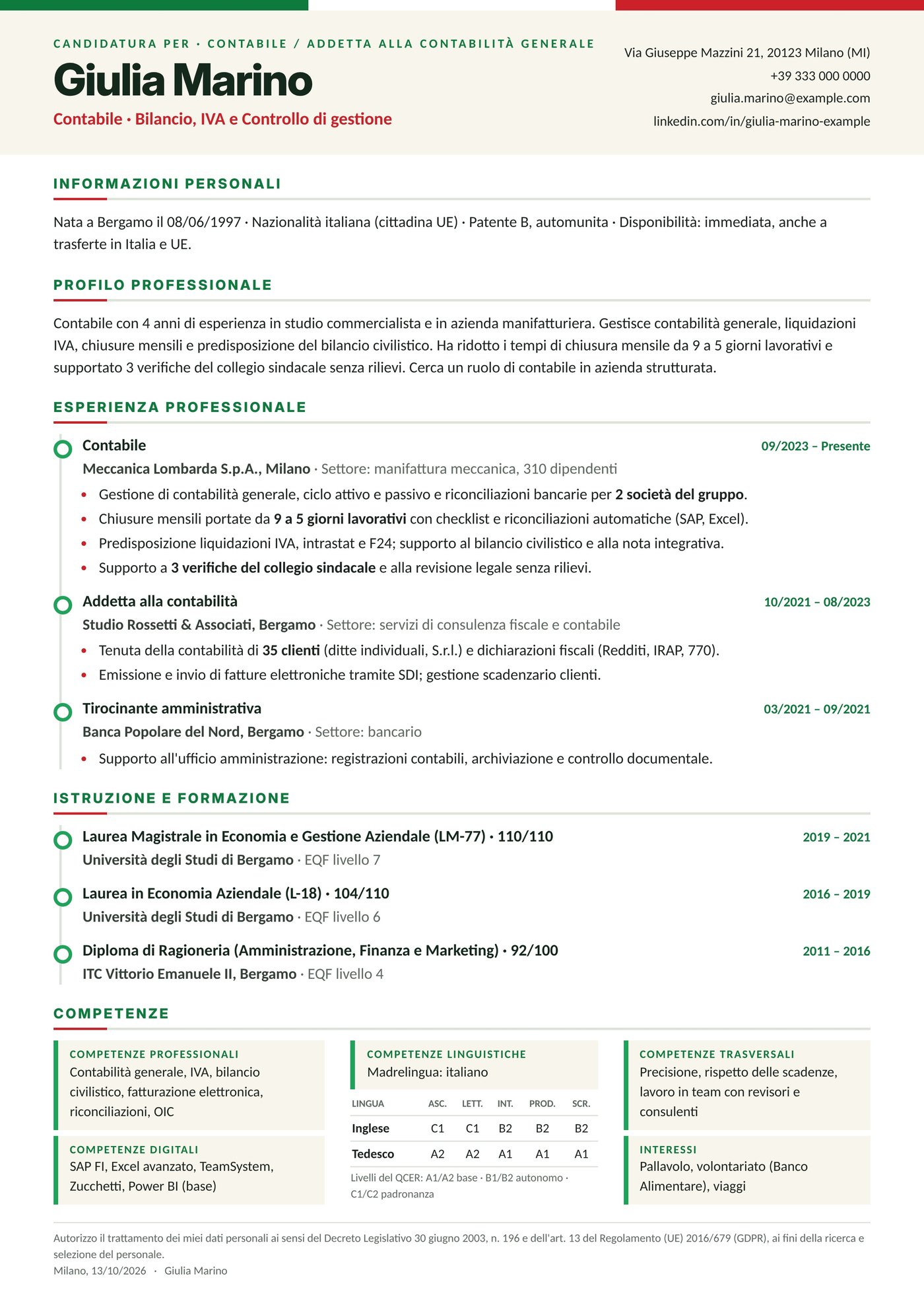
Italy CV format: Curriculum Vitae (Accountant resume example)
Italian · Accountant, Milan. Design: Cream header with a tricolore stripe, green timeline and a GDPR privacy line at the foot.
The privacy sentence is not legally required, because D.Lgs. 101/2018 means consent is not the only legal basis, but it is strongly recommended: without it a recruiter may not be authorised to use your contact details.
Place it at the bottom of the CV, after experience, education, skills and languages, in a smaller font (about 9–10 pt against 11 pt for the body).
Cite both D.Lgs. 196/2003 and the GDPR (Regulation (EU) 2016/679); avoid the older wording that mentions only the 2003 decree.
More Italy CV rules
Describe education with levels (EQF) and languages with the CEFR grid (QCER in Italian).
Also searched as: curriculum vitae modello, esempio curriculum vitae, CV italiano, curriculum Europass
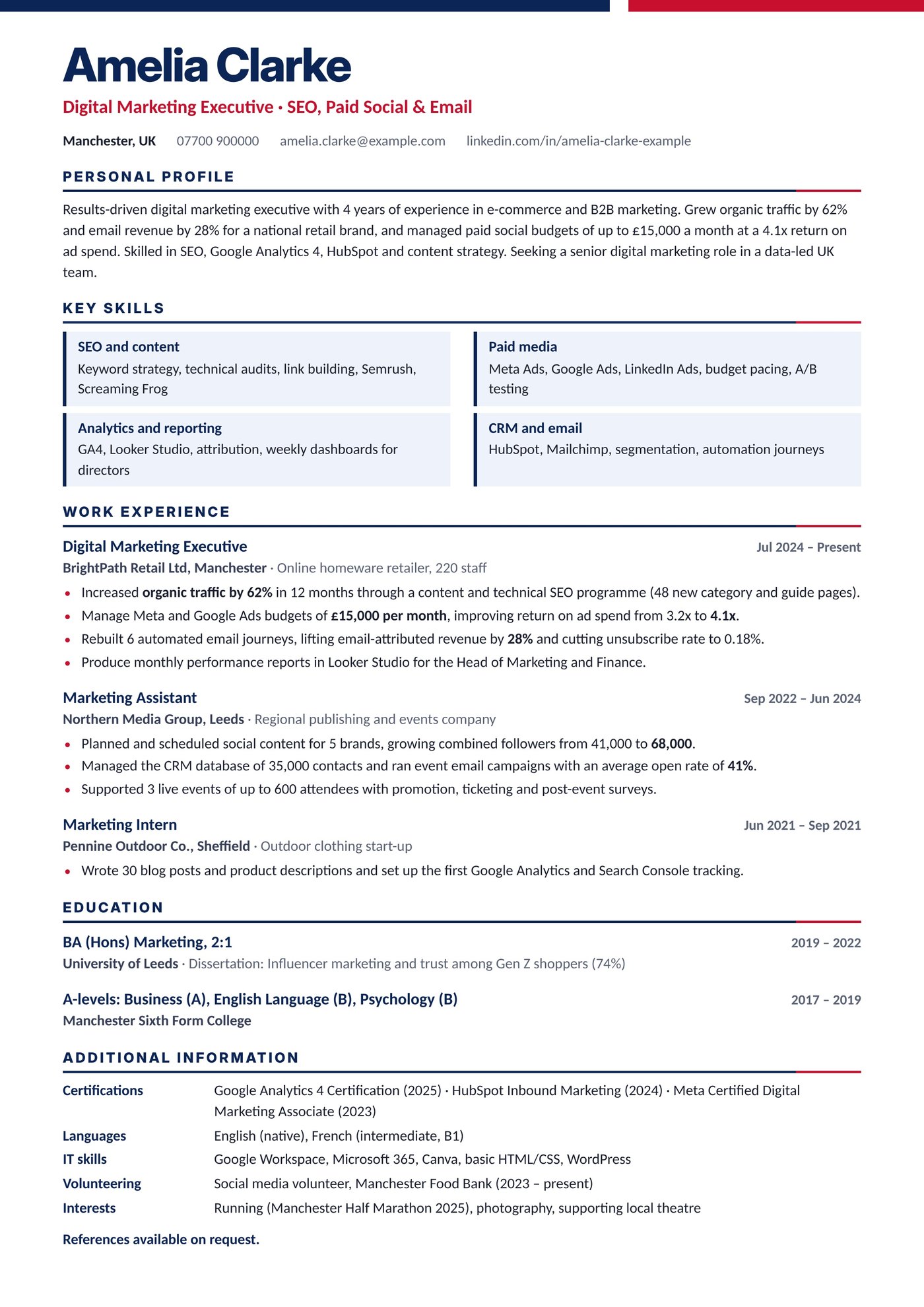
United Kingdom CV format: CV (Digital Marketing Executive resume example)
English · Digital Marketing Executive, Manchester. Design: Single-column layout with navy and red rules, key-skills tiles and no photo.
One to two full pages; avoid half pages.
Leave the photo out; employers do not expect one.
Give name, UK address or city, email, phone and optionally LinkedIn; do not add a "Curriculum Vitae" heading.
More United Kingdom CV rules
Use simple layouts and bullet points; complex templates and tables may not pass applicant tracking systems.
Typical order: personal details, personal profile, key skills, education, work experience, additional information, optional interests, then references on request.
Also searched as: UK CV template, British CV example, CV format UK
Danish · Project Manager, Aarhus. Design: Rose hero card with a round photo, red markers and warm-grey competency tiles.
Most employers prefer one to two pages; tailor the CV to each job and keep a complete master version.
Order: summary, core competencies, work experience, education and courses, IT skills, languages (oral and written level), a little about you as a person, and a note that references are available.
The summary is 5–7 lines on your motivation and what you offer the employer.
More Denmark CV rules
A photo is optional: most companies surveyed view it positively, but some HR systems hide photos; use a professional portrait.
State that references are available on request instead of attaching reference letters.
Also searched as: CV eksempel, CV skabelon, dansk CV
Swedish · UX Designer, Stockholm. Design: Blue header with a yellow Nordic-cross line running down the page and a date-and-skills left column.
Keep it to two A4 pages at most and focus on experience relevant to the job.
A photo is optional; if used, make it professional, neither too casual nor too stiff.
A home address is probably unnecessary because employers usually contact you by phone or email.
More Sweden CV rules
Use easy headings such as work experience, education, language skills and computer skills, with the most relevant and recent entries first.
Leave references off the CV; they matter later in the process. Save as a PDF with your name in the file name; write in English if you do not speak Swedish.
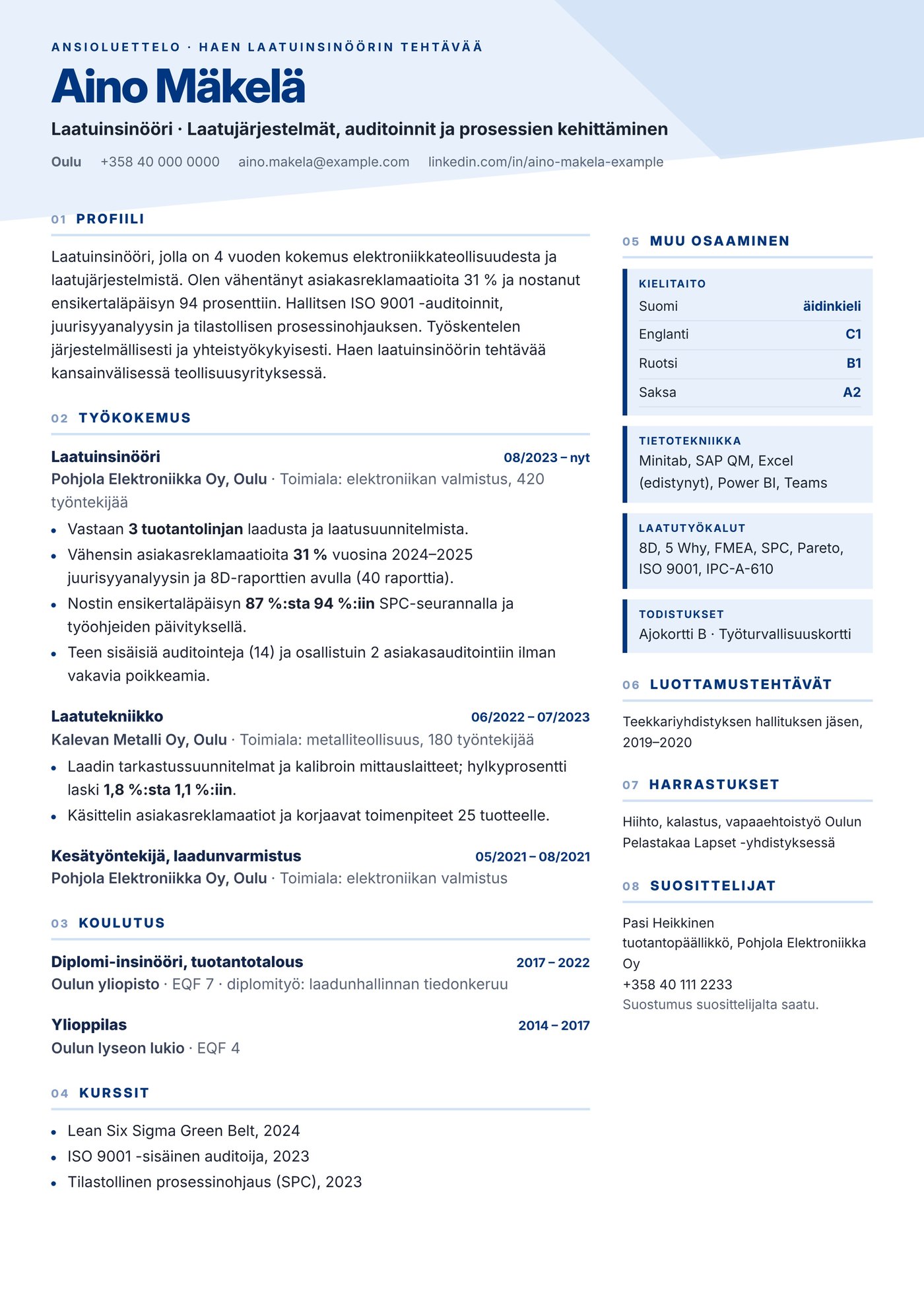
Finland CV format: Ansioluettelo (CV) (Quality Engineer resume example)
Finnish · Quality Engineer, Oulu. Design: Ice-blue diagonal header, numbered sections and a boxed right column.
A CV is usually one to two pages; the cover letter is usually a little under one page.
A photo is optional; check the job advert first, because some recruitment is anonymous and employers may not want a photo.
A short summary or profile at the top is allowed; main sections are work experience, education, courses and other competence (languages, IT skills, certificates).
More Finland CV rules
List work and education in reverse chronological order and include only experience relevant to the job.
Include references only if the people agreed, with their contact details; send CV and application as PDF files.
Also searched as: CV malli, CV esimerkki, suomalainen CV
Norwegian · Project Engineer, Stavanger. Design: Red, white and navy top bands, a key-qualifications box and a vertical timeline.
Stay within two pages; a one-page version can be useful for career days.
Reverse-chronological order, with your name in bold and larger than the rest, and address, phone, email and date of birth under it; do not write "Curriculum Vitae".
A photo is optional; if used, choose a neutral background.
More Norway CV rules
Describe language skills in words such as "fluent" or "basic" rather than codes; write the CV in the same language as the advert.
Either write that references are available on request or list two to three, always after asking them first.
An article for newcomers recommends opening with a "key qualifications" summary tailored to the job.
Also searched as: CV mal, CV eksempel Norge, norsk CV
Russia is outside the EU and Europass, and candidates typically follow the form structure of the main job site, hh.ru.
Russia CV format: Резюме (rezyume) (Financial Analyst resume example)
Russian · Financial Analyst, Moscow. Design: Charcoal header band with a photo, red section markers and a tinted right column.
Structure follows the hh.ru form: photo and contacts, desired salary, experience, education, key skills and "About me".
A professional, neutral photo helps.
Give only your city or nearest metro station, not your full home address.
More Russia CV rules
Desired salary is optional; hh.ru suggests about 15–20% above current pay if you state it.
Experience is the main section: focus on the last three years, list concrete results and use recognisable job titles; list only relevant education and specific key skills.
Also searched as: образец резюме, резюме на русском, шаблон резюме
Local language and proofreading: the German, French, Italian, Russian, Danish, Swedish, Dutch, Finnish and Norwegian samples are written in the local language. Have a native speaker proofread your final text. Switzerland and Norway are not EU members but appear on Europass’s list of participating non-EU countries; the UK and Russia do not.
27 Europass CV samples by job
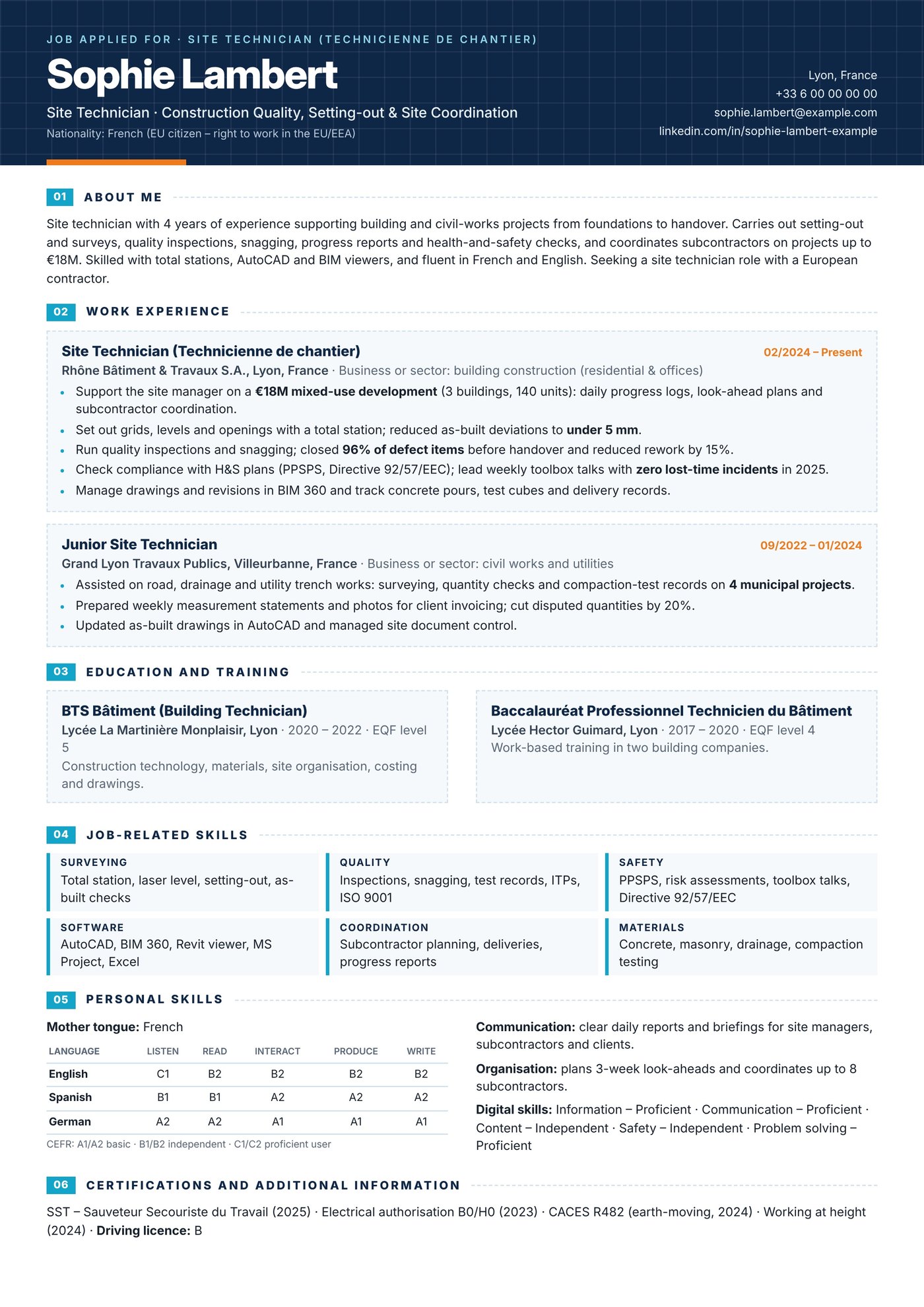
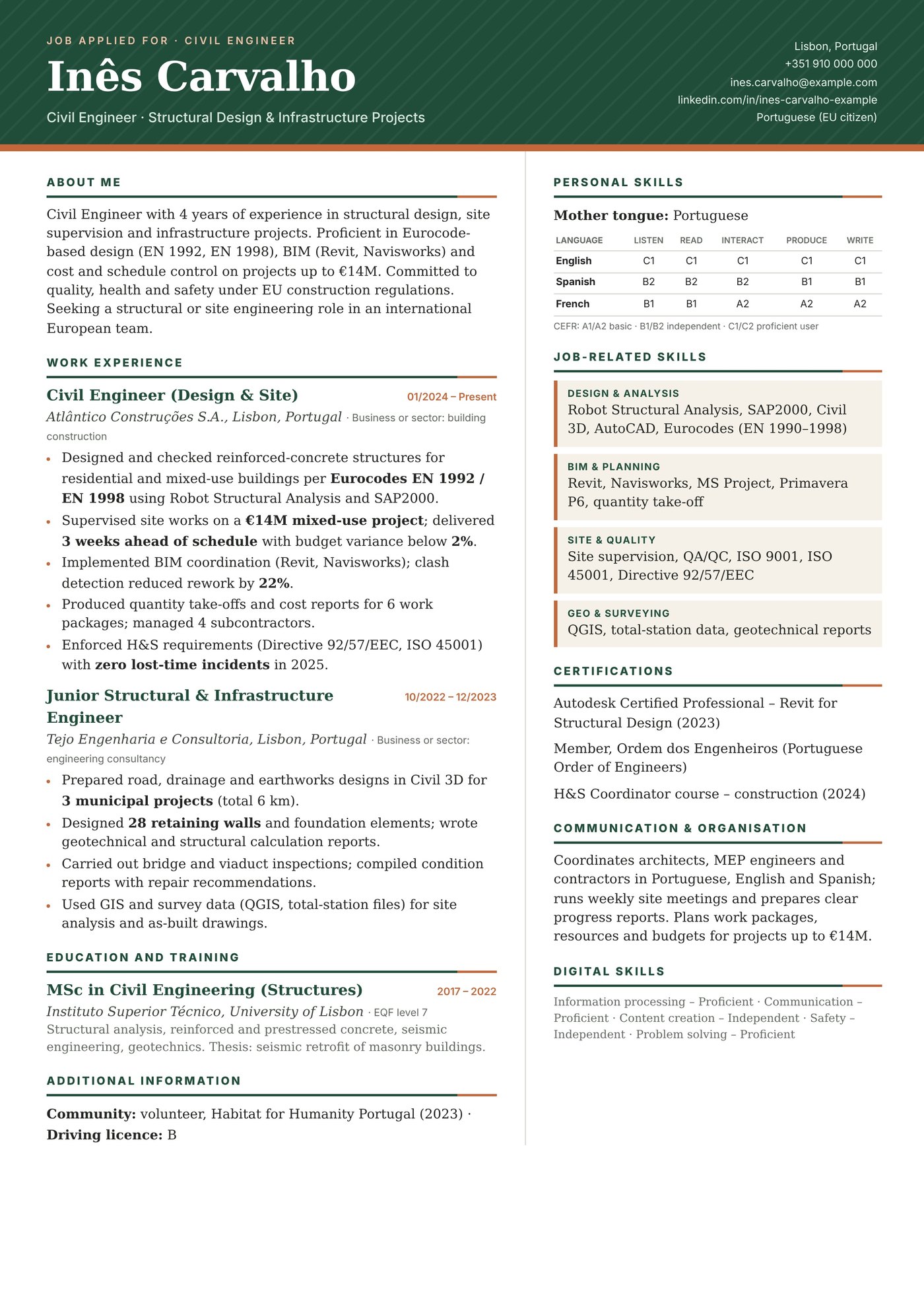
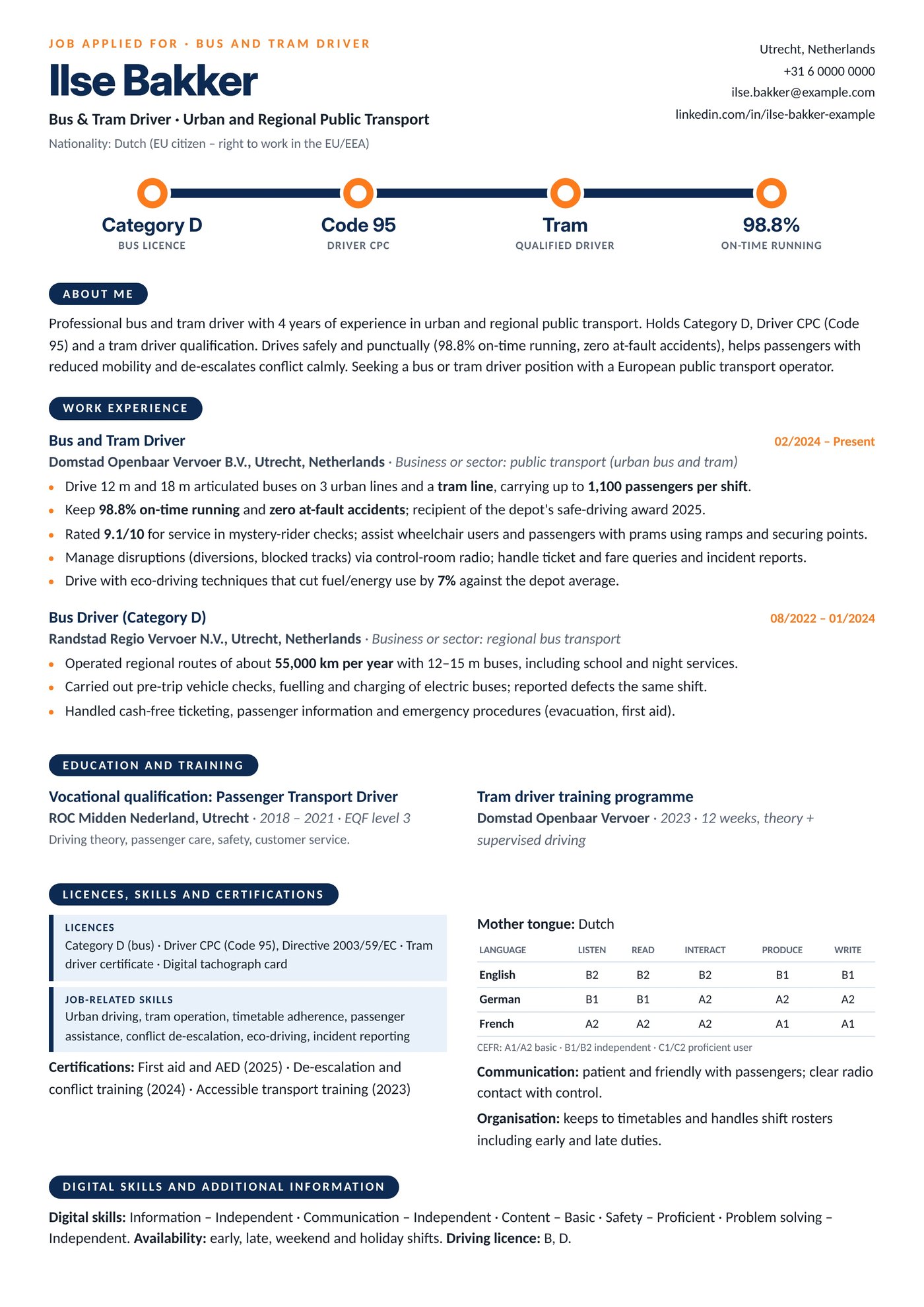
Every sample is a fictional candidate with 3–4 years of experience, shown as a JPG preview with a text PDF to download. Click an image to open the full-size version. Each design is different, so you can compare layouts before choosing one.
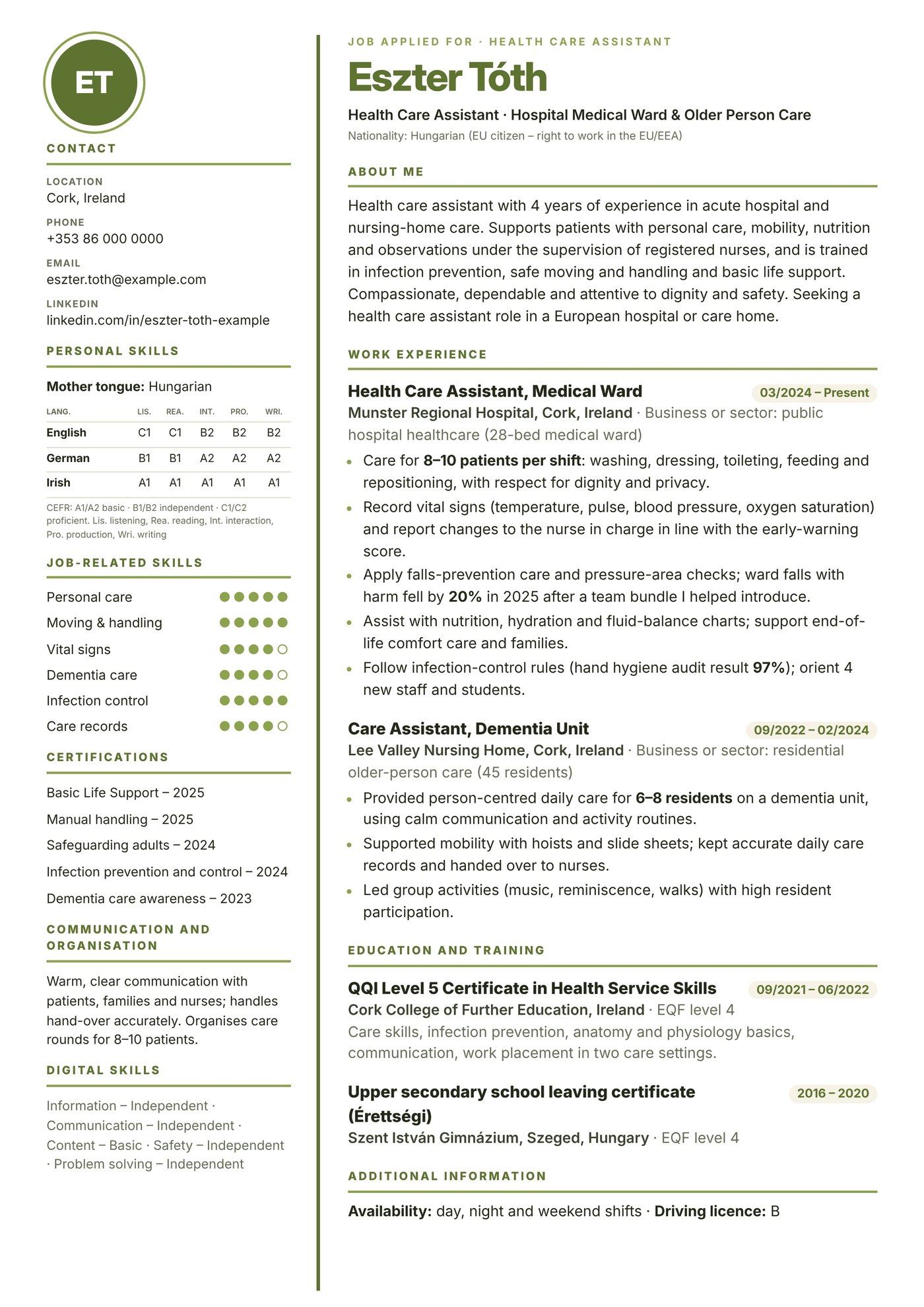
Healthcare CV samples (7)
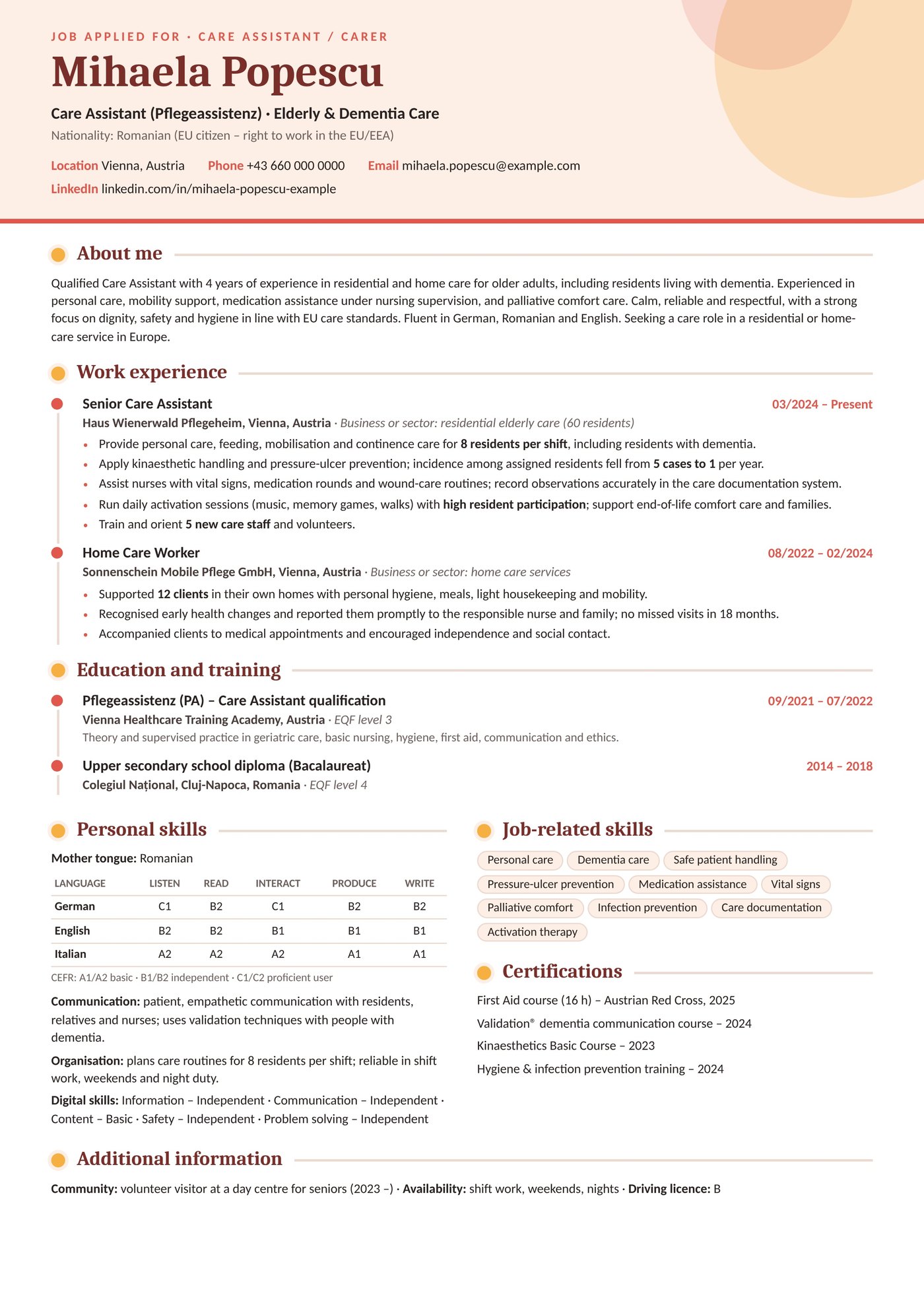
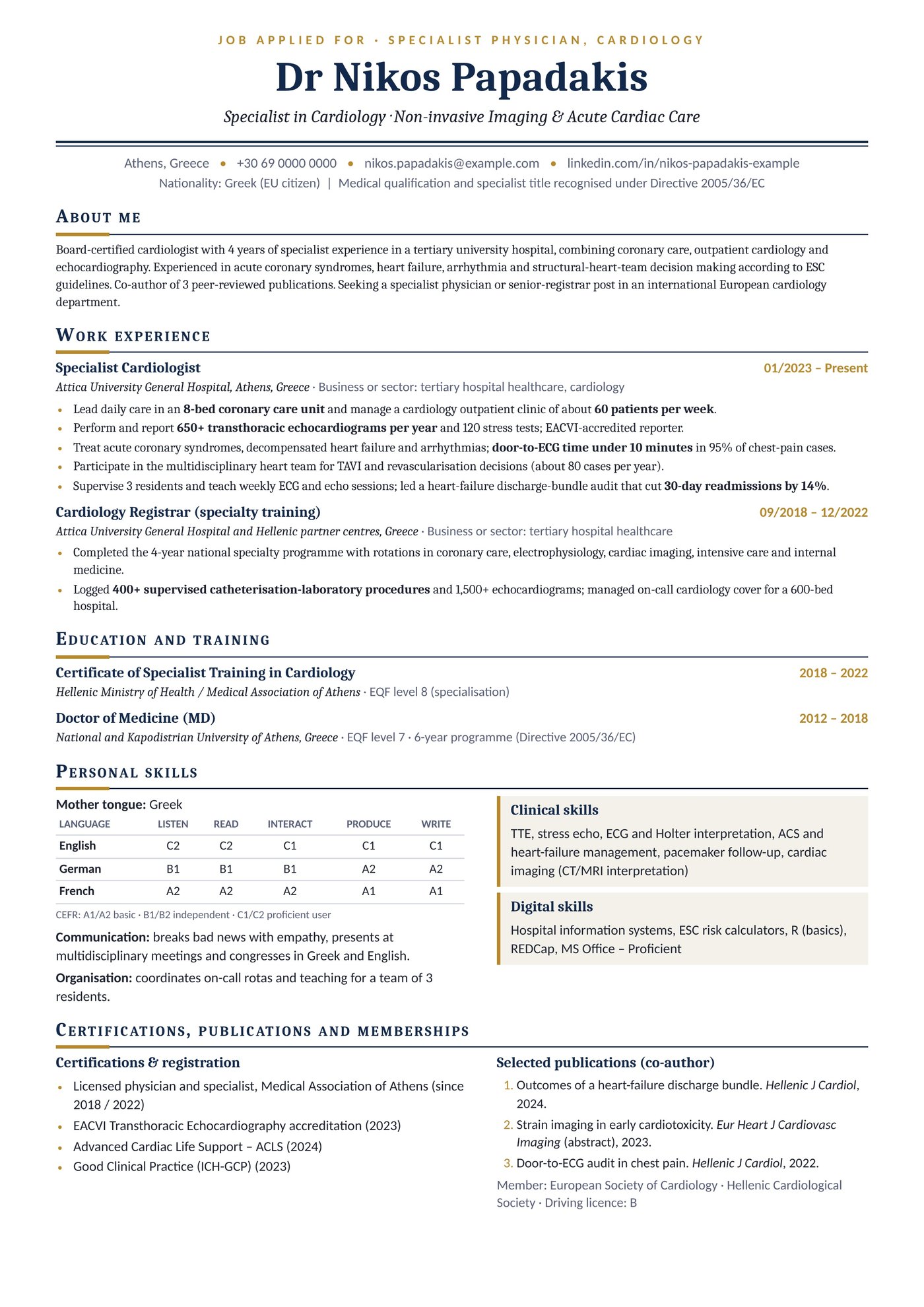
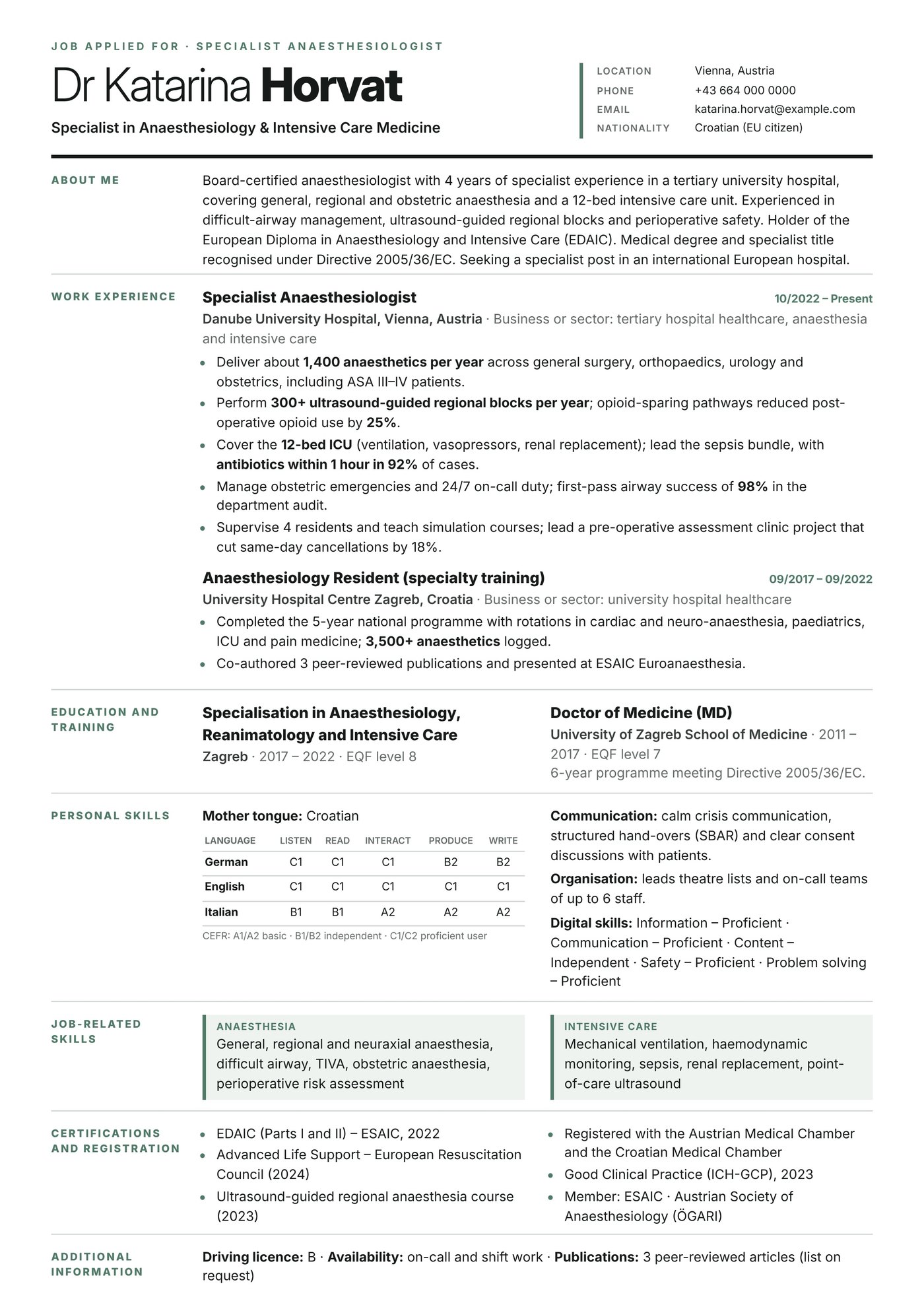
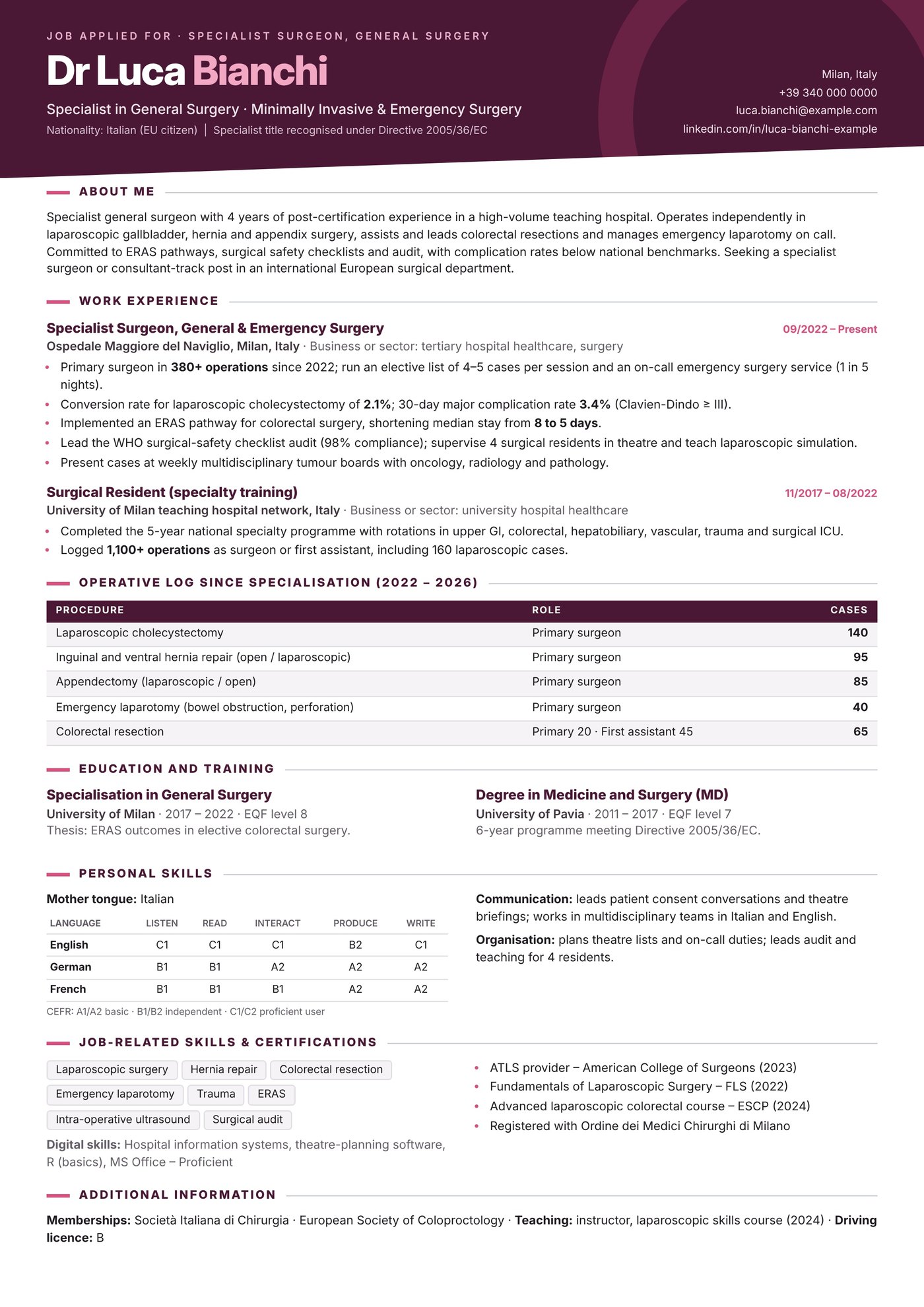
Doctors, nurses and care workers sit at the top of Europe's shortage list. These seven samples show how to present registration, specialty training, clinical volumes and mandatory certificates on a European CV.
EU shortage occupation: Nursing professionals (20 of 28 countries)
Registered General Nurse CV Sample – Dublin, Ireland
Design: Teal rounded header with stat tiles and a two-column body.
Acute medical and emergency nursing, INEWS escalation, sepsis bundle results, NMBI registration and a Directive 2005/36/EC note.
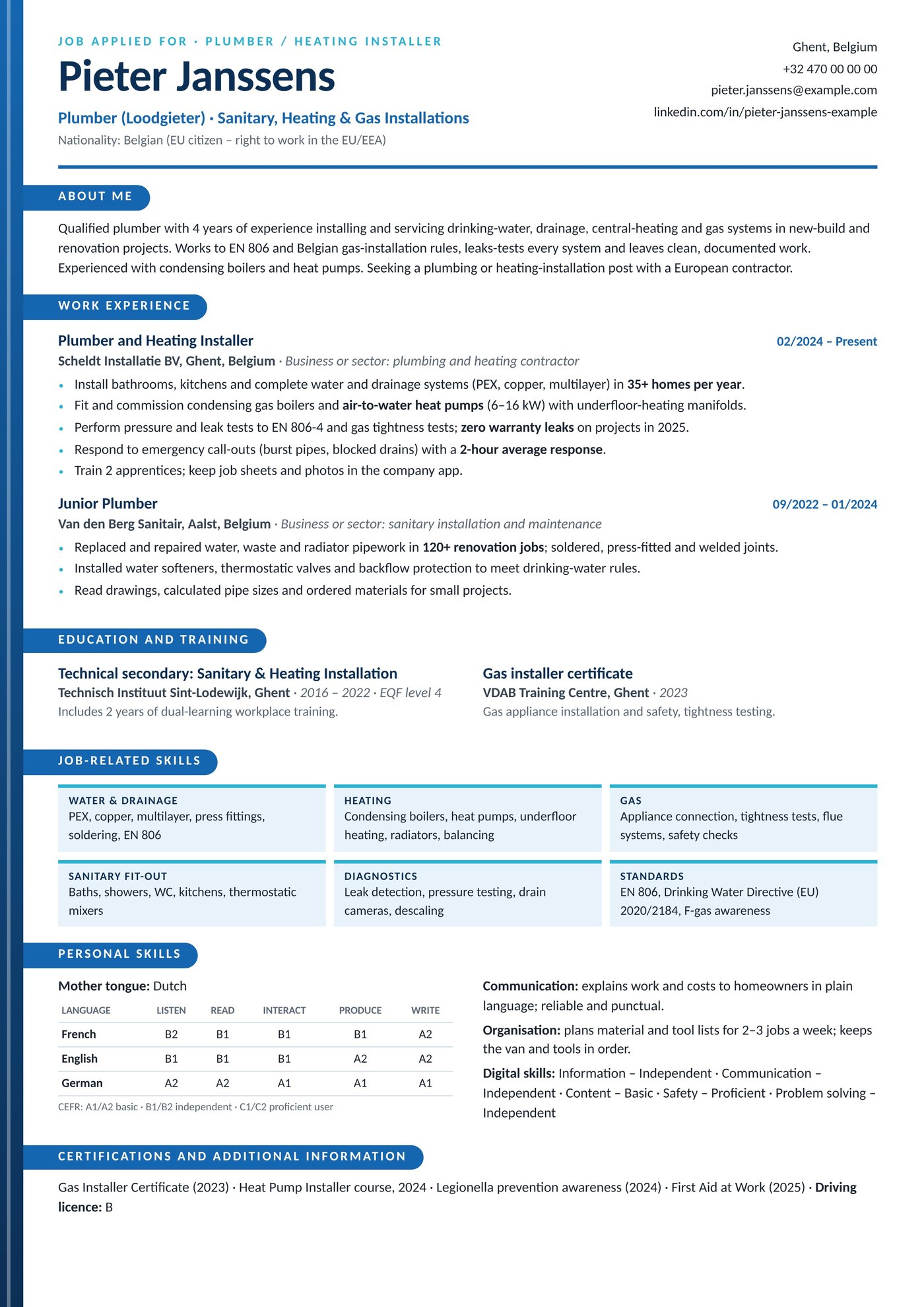
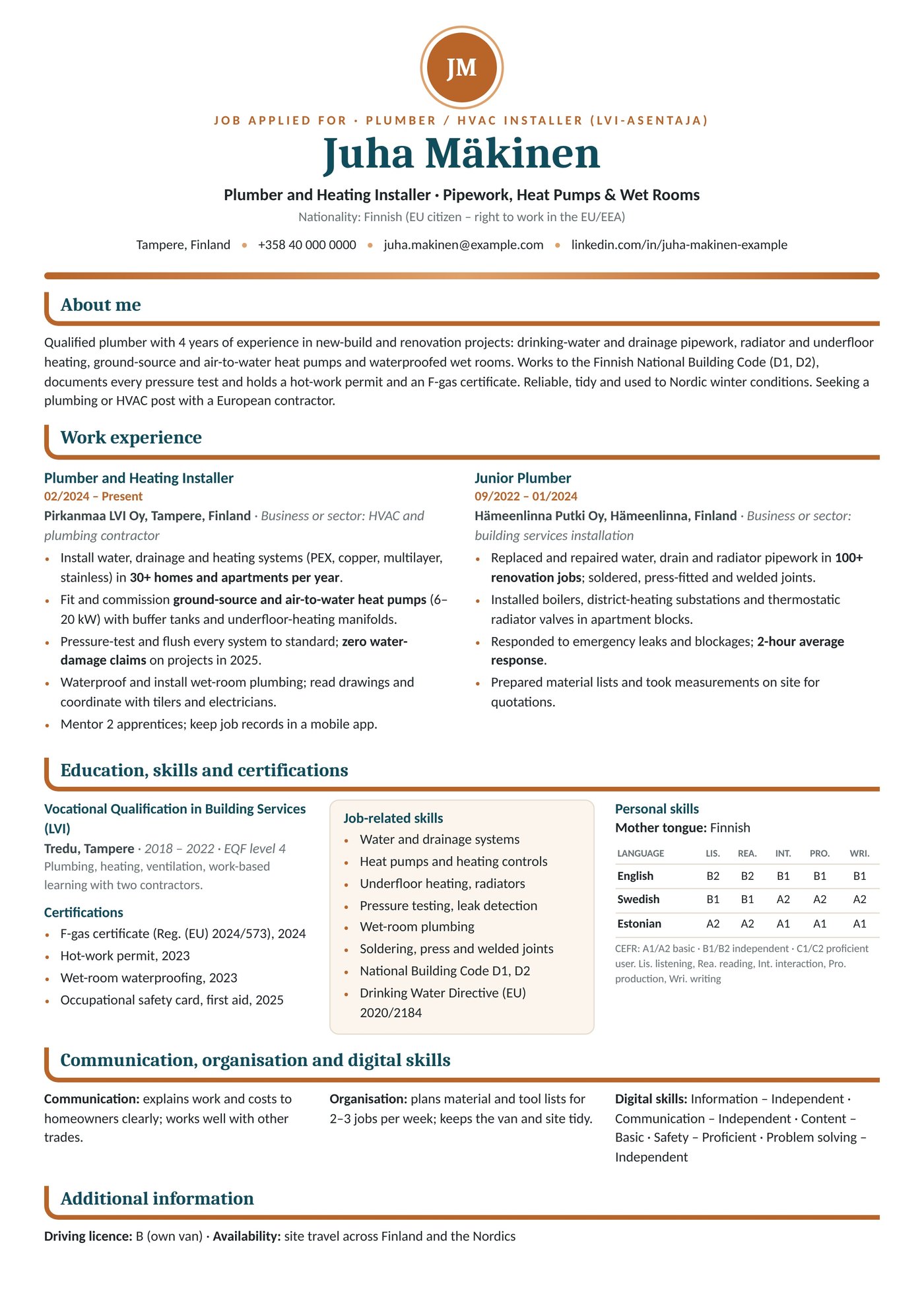
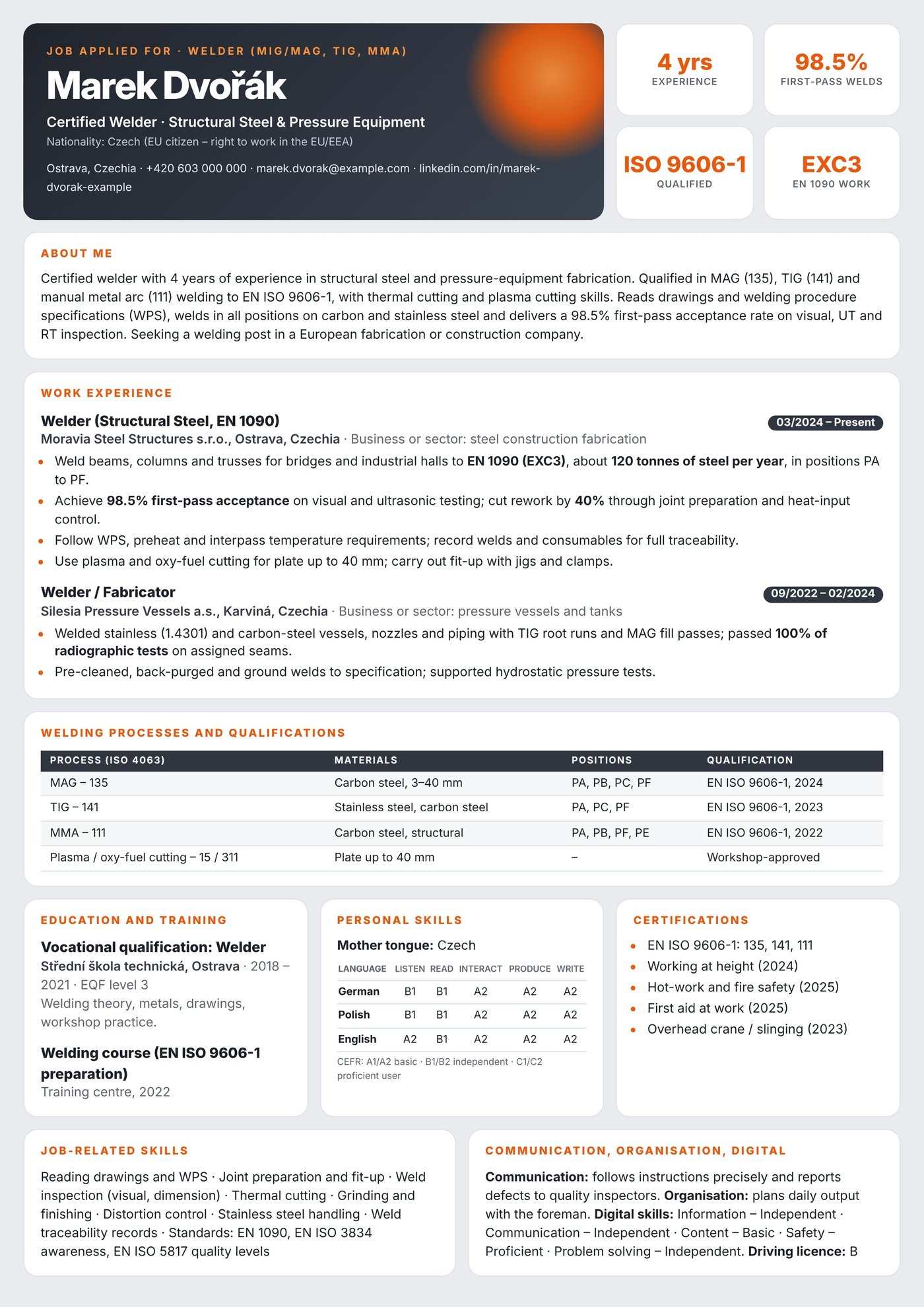
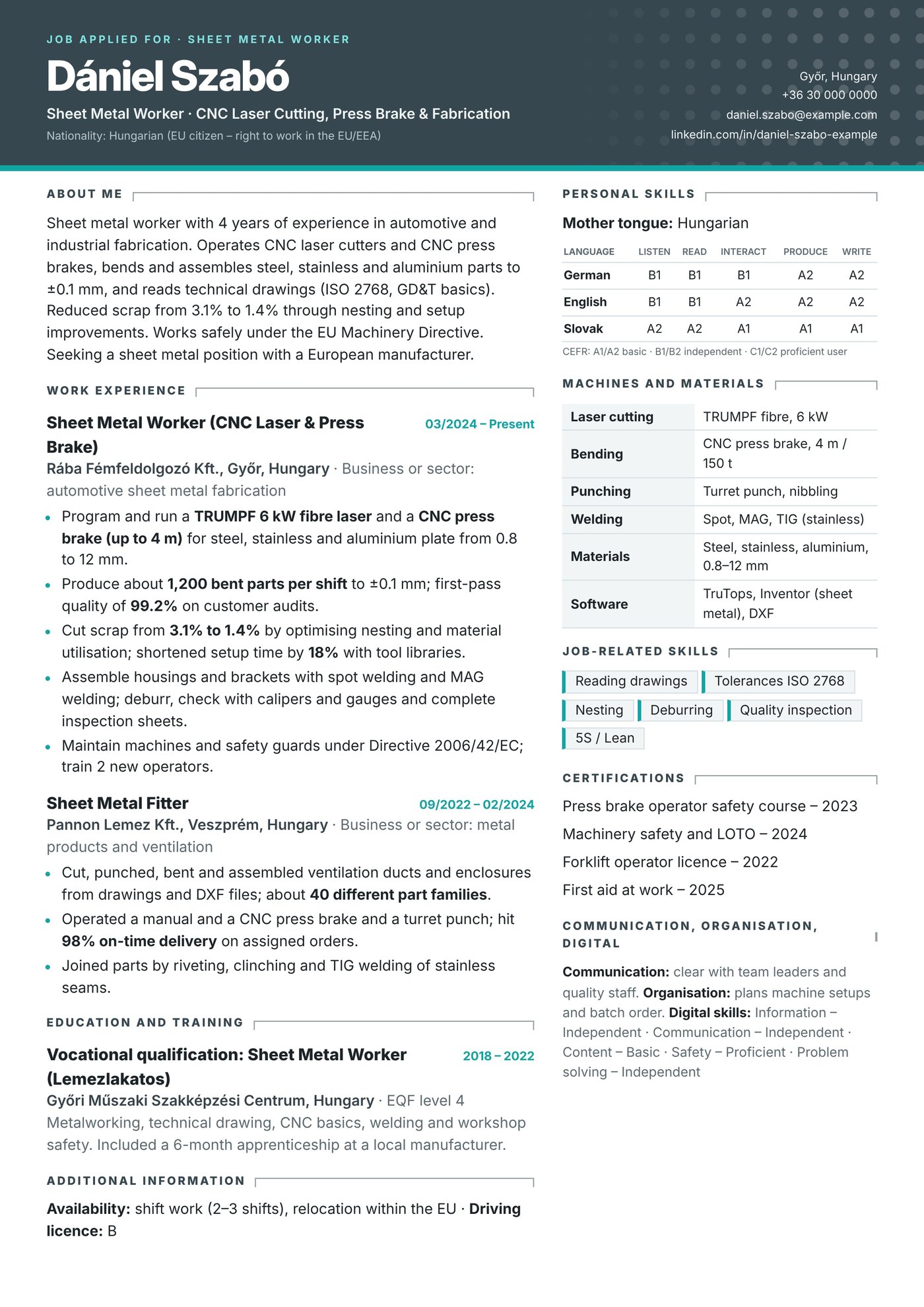
Electricians, plumbers, welders and sheet metal workers are among the occupations reported short in the most countries. These samples put licences, standards and safety records where hiring managers look first.
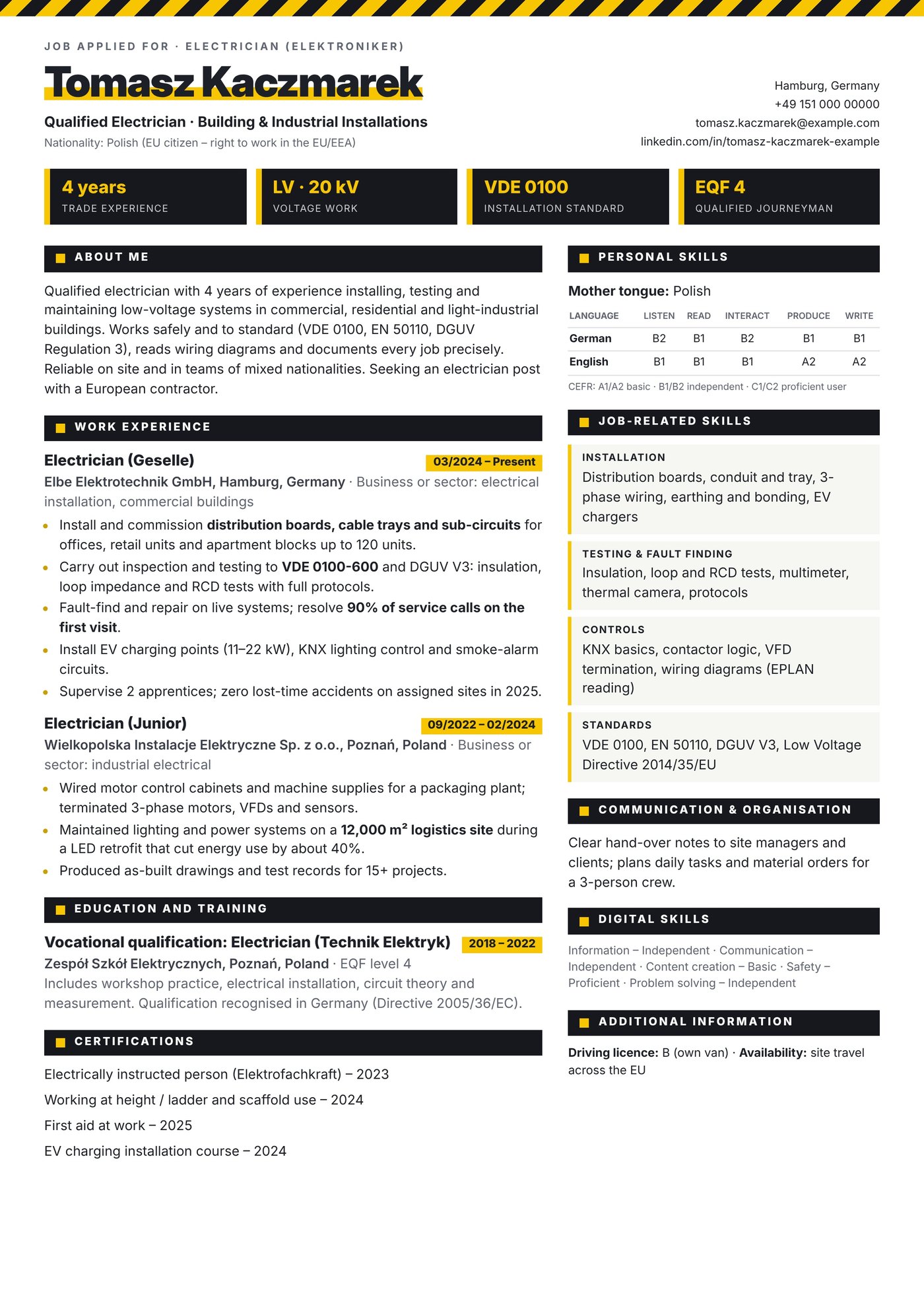
EU shortage occupation: Building and related electricians (21 of 28 countries)
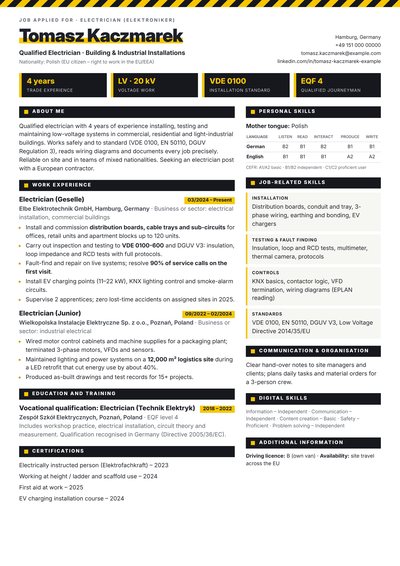
Electrician CV Sample – Hamburg, Germany
Design: Black and safety-yellow with hazard stripes and spec tiles.
Low-voltage installation and testing to VDE 0100, EV chargers, KNX controls and an EQF level 4 vocational qualification.
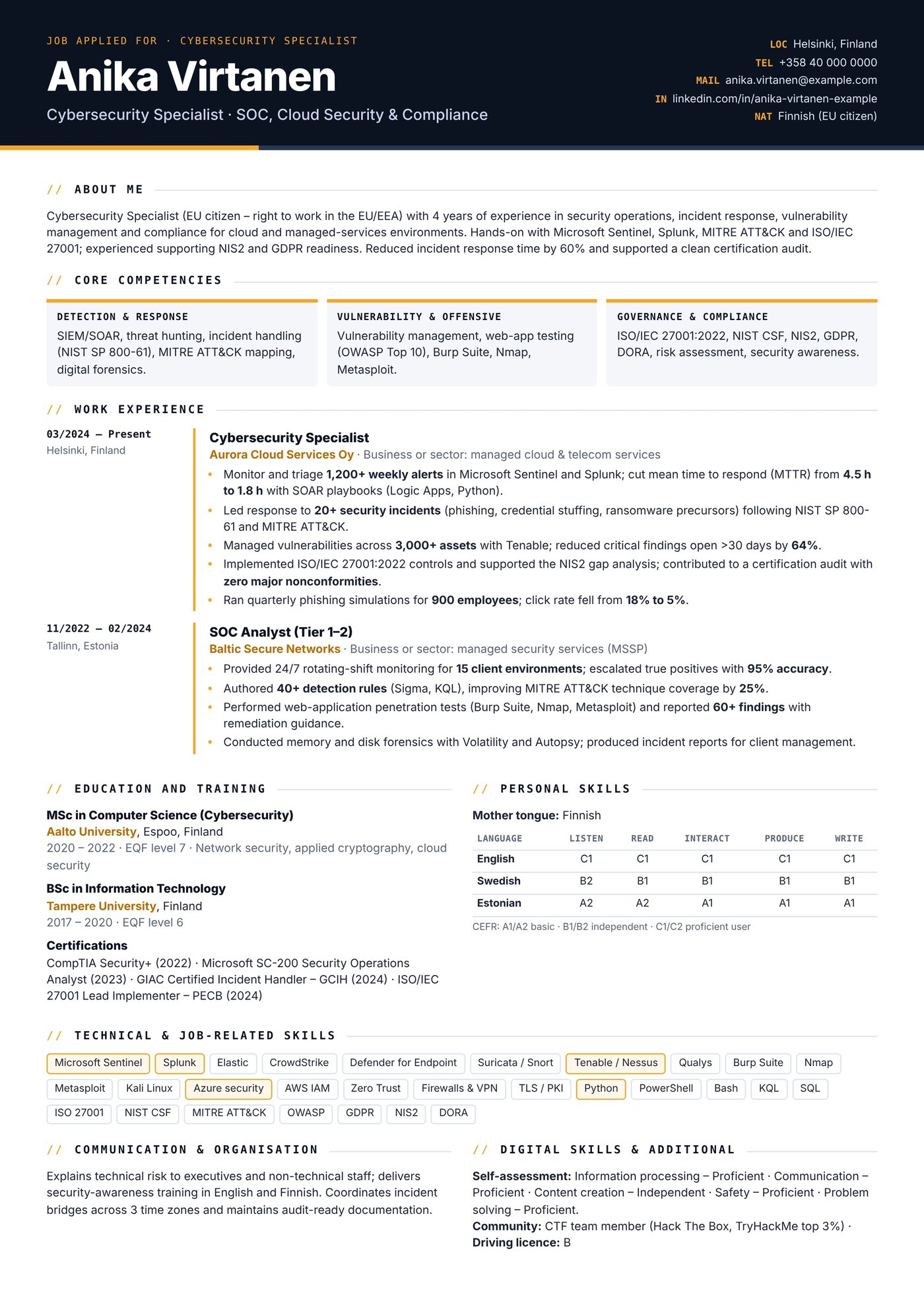
Seven designs for engineers and IT professionals with 3–4 years of experience, each with a CEFR language grid, EQF education levels and a digital-skills self-assessment.
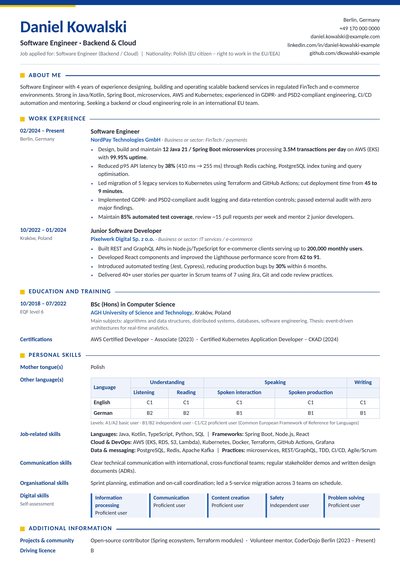
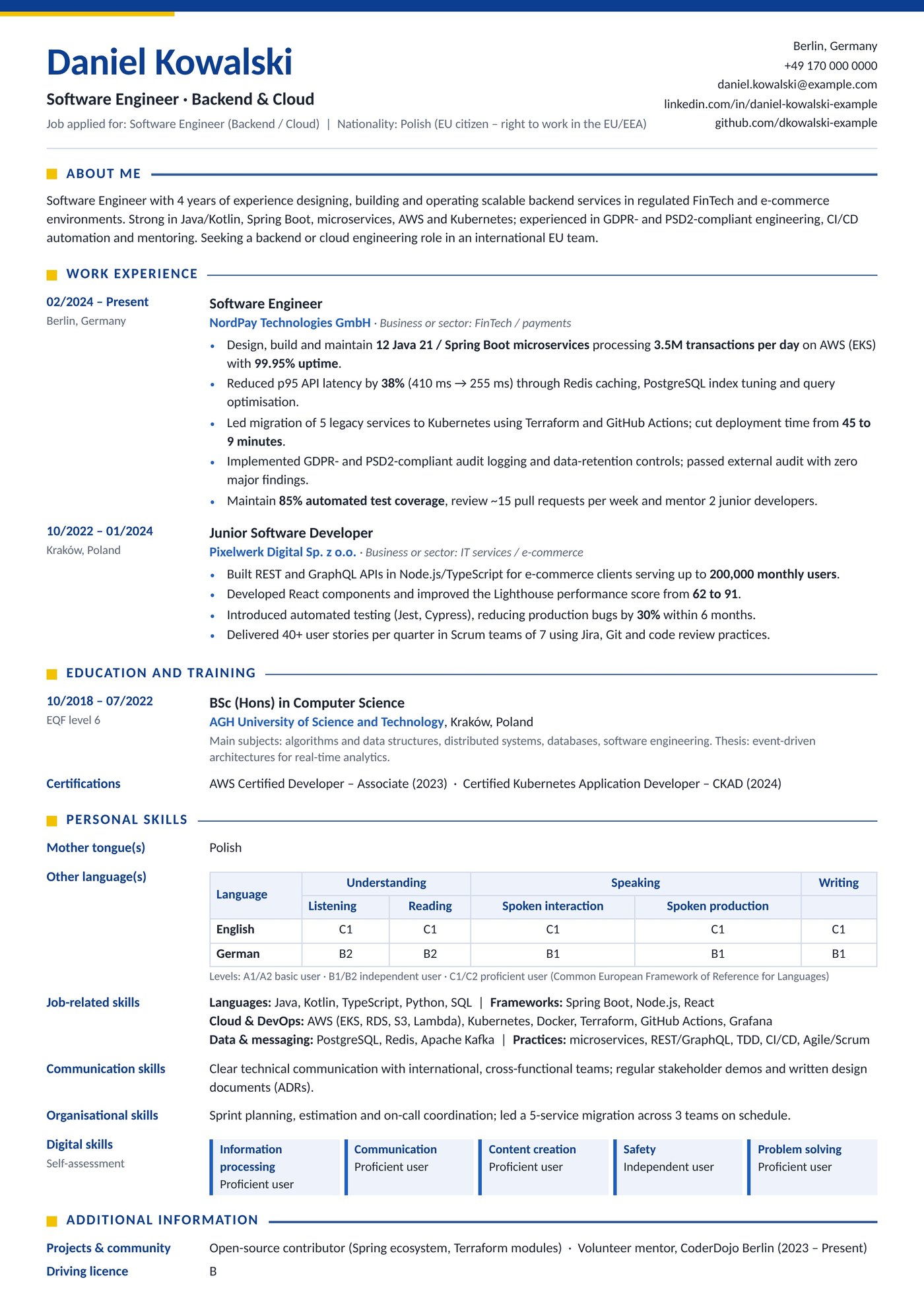
Software Engineer CV Sample – Berlin, Germany
Design: Classic Europass blue with a date column and a digital-skills strip.
Java and Kubernetes backend work, GDPR- and PSD2-aware engineering, AWS and CKAD certifications and CEFR language grid.
Heavy-truck, bus and tram drivers are on the shortage list, and warehouse and supply-chain roles are widely advertised. These samples foreground licences, tachograph and driver-CPC details and measurable results.
Warehouse Operator CV Sample – Venlo, Netherlands
Design: Violet with a barcode motif and an equipment-and-licences table.
Reach-truck and order-picking output, pick accuracy and inventory-variance results, SAP EWM and VCA safety certificate.
Fictional examples: names, employers, figures and contact details in these samples are invented. JPG files are for viewing; use a text-based PDF for online applications so an ATS can read the text.
Europe’s most in-demand jobs and the Europass CV Templates & European Resume Samples that match
The European Labour Authority’s 2025 EURES report ranks occupations by the number of countries reporting shortages.
Source: EURES Report on labour shortages and surpluses 2025 (European Labour Authority). Counts cover 28 reporting EURES countries; each national office uses its own methodology, so compare with caution.
Health and care is the most persistent shortage sector, and construction trades such as electricians, plumbers, roofers and air-conditioning mechanics have grown, partly because of climate-related policy demand. Hospitality shortages are easing. On the other side, surpluses are reported for graphic and multimedia designers (19 countries), office cleaners, general office clerks, secretaries and shop sales assistants, which means candidates in those fields face more competition.
How to adapt a Europass CV for a European job application
Read the vacancy first. Copy the exact job title, standards, licences and tools into your profile and skills where they are true.
Choose the right design. Conservative sectors (finance, public sector, medicine) suit a clean single-column or table layout; trades and technical roles can use a stronger visual design, as long as the text stays selectable.
Show your level of every language with CEFR and, for qualifications, the EQF level.
Put licences and registrations up front for regulated jobs: medical registration, nursing board numbers, driver CPC, ADR, welding qualifications and safety cards.
Add numbers to achievements (volumes, accuracy, savings, safety), and keep each bullet to one or two lines.
Match photo and personal data to the country. Include only what the employer expects or requests.
Export the right file. Upload a text-based PDF to the ATS and keep the JPG for sharing and previews.
Write a short cover letter that says why this employer and how your experience answers their requirements, if the vacancy asks for one.
Need a professional Europass or European-format CV?
Bhatia Consultancy Services prepares ATS-optimised CVs, cover letters and application documents for roles across Europe. Send us your experience and the vacancy, and we will match the structure, language levels and licences to the employer’s expectations.
A Europass CV is a standardised CV created with the European Commission's Europass service. You first build a Europass profile (education, training, work experience and skills) and then generate one or more CVs from it, choosing which information to include and a design. CVs can be created, stored and shared in 31 languages.
Is Europass free to use?
Yes. The Europass site describes its profile, CV editor, cover letter editor and other tools as free online tools, and says European digital credentials are issued free of charge. You need to log in or register to use the editor.
Do employers in Europe require a Europass CV?
No. Europass is widely recognised but not mandatory. Germany's official Make it in Germany portal, for example, says companies there usually appreciate an individual design, so Europass is best used as a guide that you adapt. Always follow the instructions in the vacancy.
How long should a European CV be?
There is no single EU-wide page limit. A Dutch EURES-style handout recommends a maximum of two pages, with some professions (such as ICT) needing more, and the UWV-based Dutch guide suggests one to two pages. The Make it in Germany portal does not set a length. The samples on this page use one A4 page for 3–4 years of experience.
Should I put a photo on my European CV?
It depends on the country and employer. The German portal says applicants are often expected to include a photo, while Dutch guidance based on the national data-protection authority advises leaving out unnecessary personal data such as a photo, date of birth and marital status unless the employer asks. Check the vacancy and national practice.
What are CEFR levels and why do they matter on a Europass CV?
The Common European Framework of Reference for Languages describes language ability in six levels: A1 and A2 (basic user), B1 and B2 (independent user) and C1 and C2 (proficient user). Europass-style CVs list each language by level for listening, reading, spoken interaction, spoken production and writing. Germany's official portal also recommends CEFR levels, for example "English: C1".
What is the EQF level on a Europass CV?
The European Qualifications Framework has 8 levels that describe learning outcomes, from level 1 (lowest) to level 8 (highest). Listing the EQF level next to your qualification helps employers in other countries compare it with their own system.
Will an ATS read my Europass CV if I upload a JPG?
No. A JPG is an image, so applicant tracking systems cannot extract its text. Upload a text-based PDF (or the format the employer asks for) and use the JPG for viewing or sharing. The sample images here are previews of the designs.
Is the CV format the same in every European country?
No. Photo, length and personal-data habits differ. For example, Swiss and Austrian guidance describes a photo as expected or customary, UK guidance says to leave it out, French guidance calls it optional unless the advert asks, and Dutch guidance advises leaving it out unless needed. Always follow the vacancy.
Do I need a privacy sentence on an Italian CV?
Italian recruiting guidance says it is not legally required after D.Lgs. 101/2018 but is strongly recommended. Place it at the bottom in a smaller font and cite D.Lgs. 196/2003 and the GDPR (Regulation (EU) 2016/679).
Are Switzerland, Norway, the UK and Russia covered by Europass?
Switzerland and Norway are on Europass's list of non-EU participating countries. The UK and Russia are not on that list, which is why their samples follow local conventions instead of the Europass layout.
Can I download a free Europass CV template or sample?
Each of the 39 samples on this page has a JPG preview and a text-based PDF to download. They are filled-in sample CVs showing structure, wording and design, not editable Word templates. To build your own for free, use the official Europass editor and follow the section order shown here.
What is the best CV format for Germany, France, the UK or Italy?
Use each country's own format: a tabular Lebenslauf in Germany, a one-page CV with a target job title in France, a one-to-two-page photo-free CV in the UK, and an Italian curriculum vitae with a GDPR privacy sentence at the bottom. The country samples above show each format in the local language.
Where can I find CV examples for Switzerland, Austria and the Nordic countries?
The country section includes sample CVs for Switzerland, Austria, Denmark, Sweden, Finland, Norway and the Netherlands, each with its local rules, such as photo, length, personal data and references.
Are the sample CVs real people?
No. Every sample is a fictional candidate with placeholder contact details, created to show structure, wording and layout for 3–4 years of experience. Replace the content with your own verified experience and qualifications.
📍 Germany, Europe · 📅 Updated 2026 · ⏱ 10 min read
Resume Writing Services in Germany: The Complete 2026 Lebenslauf Guide
Germany’s job market is booming — but here is what most applicants miss: alongside your qualifications, a professionally crafted Lebenslauf (German-style CV) is what actually gets you the interview. German recruiters follow stringent evaluation standards, and a generic resume can cost you the role despite strong credentials. Professional resume writing services in Germany are the strategic edge that changes everything.
67%
More Interview Invitations
92%
Formatting Compliance Rate
78%
Fewer Rejection Errors
30+
Countries Served
🏆 Germany’s Most Trusted CV Writing Service — Lebenslauf Experts, ATS-Optimised, 15+ Years Experience Get Started →
Germany’s economy remains one of Europe’s strongest — but the hiring landscape is shifting fast. Remote work persists across many sectors, AI is reshaping skill demands, and the country faces an acute skilled labour shortage in trades, healthcare, and technology.
The result? Employers have become more selective. A generic, poorly formatted Lebenslauf can eliminate an otherwise excellent candidate within seconds of recruiter review. German recruiters are precision-focused — they expect documents that are structured, fact-driven, and perfectly formatted.
“In Germany, precision and professionalism are paramount. A top-tier Lebenslauf isn’t just nice to have — it’s non-negotiable if you want to compete for the best roles.”
Three trends shaping German hiring right now:
🤖
AI & AutomationRoutine roles are being streamlined — but critical thinking, creativity, and AI management skills are surging in value.
🌱
Green Jobs BoomRenewable energy, sustainability, and EV sectors are growing rapidly — creating genuinely new professional roles across Germany.
🔧
Skilled Labour ShortageTrades, healthcare, and IT are struggling to fill roles despite high demand — making a strong CV even more valuable to stand out.
The bottom line: your Lebenslauf must reflect these shifts. Generic applications simply won’t get far in 2026’s German job market.
Section 02
Most In-Demand Jobs in Germany Right Now
These sectors are actively hiring across Berlin, Munich, Hamburg, Frankfurt, and beyond — and our specialist writers cover every one of them.
🏥
Healthcare & Nursing
Germany’s aging population drives relentless demand for nurses, caregivers, medical technicians, and geriatric care specialists.
→Registered Nurses & Caregivers
→Medical Technicians
→Geriatric & Mental Health Specialists
🌱
Green Energy & Sustainability
Engineers, project managers, and policy advisors are needed as Germany accelerates its wind, solar, and environmental regulation programs.
→Renewable Energy Engineers
→Sustainability Consultants
→Environmental Policy Advisors
🔧
Skilled Trades
Electricians, HVAC specialists, and mechanics are extremely hard to find in Germany — making these trades more lucrative than ever before.
→Licensed Electricians
→HVAC & Mechanical Specialists
→Construction & Civil Trades
💻
IT & Cybersecurity
As businesses digitise rapidly, experts in cloud security, AI development, and DevOps are in exceptional demand across Germany’s tech hubs.
→Cybersecurity Analysts
→Cloud & DevOps Engineers
→AI & Machine Learning Specialists
🏭
Engineering
Germany’s industrial backbone keeps mechanical, electrical, and renewable energy engineers in constant demand across major manufacturing regions.
→Mechanical & Electrical Engineers
→Automotive & EV Engineers
→Process & Industrial Engineers
📊
Finance, Logistics & Education
As Europe’s largest logistics hub, Germany needs supply chain managers. FinTech specialists and bilingual teachers (English/STEM) are also in high demand.
→Logistics & Supply Chain Managers
→FinTech & Data Analysts
→English & STEM Teachers
Section 03
Future-Proof Careers in Germany by 2030
Looking five to ten years ahead, these career paths will see the strongest growth in Germany — driven by technology, sustainability, and demographic change.
🔬 Data Science & Analytics
The sheer volume of data being generated means professionals who can interpret and leverage this information will be indispensable across every German industry.
⚡ Renewable Energy Engineers
Germany’s push for a greener future is a long-term commitment — not a temporary trend. Solar, wind, and hydrogen projects will create thousands of specialist roles.
🤖 AI & Machine Learning Specialists
As AI integrates into healthcare, manufacturing, and finance, professionals who can develop, implement, and manage these systems will command premium salaries.
🏥 Specialised Healthcare Roles
Beyond GPs — geriatric care, telemedicine, biotech, and health data analysts will grow significantly as Germany’s population ages and digital health expands.
🔐 Information Security Analysts
Cyber threats are escalating alongside digitalisation. Ethical hackers, risk assessment specialists, and security architects remain in permanent high demand.
👥 Soft-Skill-Heavy Roles
Project managers, HR specialists, and customer success professionals who combine technical literacy with emotional intelligence and adaptability will thrive.
💡 Key Takeaway: Upskilling in digital literacy, project management, and adaptability isn’t optional — it’s a career imperative in Germany’s evolving economy. Start by positioning yourself correctly with a precision Lebenslauf.
Section 04
Germany Salary Guide 2026: What Can You Expect?
Salaries vary by region — Munich and Frankfurt lead, while smaller towns offer lower living costs but more affordable lifestyles. In high-demand fields like IT, companies are boosting salaries by 10% to attract top talent. Your Lebenslauf should position you for the upper end of each range.
Job Title
Sector
Annual Salary (€)
Software Developer
IT & Technology
€43,000 – €85,000
Data Scientist
IT & Analytics
€60,000 – €100,000
Mechanical Engineer
Engineering
€50,000 – €80,000
Sustainability Consultant
Green Energy
€45,000 – €75,000
Nurse
Healthcare
€39,000 – €50,000
Electrician
Skilled Trades
€35,000 – €55,000
Teacher (English/STEM)
Education
€30,000 – €50,000
💡 Beyond base pay: 30+ days of paid vacation, comprehensive health insurance, and flexible hours are standard in Germany. When negotiating, your Lebenslauf must showcase why you deserve the upper end of the range.
Section 05
How to Write a German Lebenslauf That Wins
A Lebenslauf (German CV) follows precise conventions that differ significantly from UK, US, or Indian resume formats. Getting this right is non-negotiable for German job applications.
1
Two Pages Maximum — No ExceptionsGerman recruiters expect a concise, strictly structured document. Two pages for most roles — never exceed this unless a program explicitly allows it.
2
Tabular Format (Tabellarischer Lebenslauf)Dates go on the left; titles and descriptions align to the right. This structured, table-like layout is the standard expected by 90%+ of German employers.
3
No Unexplained Gaps (Lückenloser Lebenslauf)Every gap in your employment or education history must be accounted for. Unexplained gaps are a major red flag for German recruiters and admissions committees.
4
Reverse Chronological OrderAlways list your most recent experience first — most recent degree before earlier ones, most recent job before previous roles.
5
Professional Photo Required (Usually)Over 85% of German universities and employers expect a professional headshot — formal, neutral background, professional attire. Include it unless guidelines explicitly state otherwise.
6
Signature RequiredSigning your CV is standard German practice — 85% of universities expect it. It confirms authenticity. Add your signature above the date at the bottom of the document.
The Four Core Sections of a German CV
📋 Header
Full name, address, phone, email, LinkedIn, date of birth (optional for some industries), and professional photo.
🎓 Education
All degrees, diplomas, institutions, dates, locations, and grades — the most critical section for university applications.
💼 Work Experience
All roles with specific dates, locations, company names, job titles, and measurable achievements — including internships and research roles.
🌟 Skills & Additional
Language proficiencies, digital skills, extracurriculars, scholarships, certifications, hobbies, and memberships.
Section 06
CVs for German University & Scholarship Applications
Germany attracted over 458,210 international students in 2023 (DAAD statistics). With 400,000+ international students enrolled, competition for top programs is intense — and your CV is the first thing admissions committees see.
🎓 CV for Master’s in Germany
98% of German universities mandate a CV for graduate admissions. Committees spend just 90 seconds reviewing each application.
✓Thesis topics for research-focused programs
✓Industry internships (65% of STEM programs prioritise these)
90% of undergraduate programs require a CV. Successful applicants demonstrate:
✓Clear educational progression with grade transcripts
✓Extracurricular leadership (valued by 83% of admissions officers)
✓Vocational training (increases acceptance by 40%)
🏅 DAAD Scholarship CV
The DAAD awarded 61,000 scholarships in 2022 with strict, program-specific CV requirements:
✓EPOS programs: Europass format with detailed professional history
✓Study Scholarships: 1-page tabular format, academic ranking
✓Research Grants: publication lists and conference participation
🛂 Resume for Student Visa (Germany)
German embassies process over 100,000 student visas annually, all requiring supporting documents including:
✓Chronological education history
✓Proof of financial resources
✓Language proficiency documentation
92%
Formatting Compliance
67%
More Interview Invitations
78%
Fewer Rejection Errors
Professional resume writers achieve these results by ensuring 92% compliance with German academic formatting standards — dramatically increasing your chances of success.
Section 07
Our Resume Writing Services in Germany
From job seekers and international applicants to PhD researchers and executives — Bhatia Consultancy Services provides end-to-end career document support for every stage of your German career journey.
📄
Lebenslauf / CV Writing Germany
Precisely formatted, ATS-optimised German CVs that meet the exact expectations of recruiters in Berlin, Munich, Hamburg, Frankfurt, and across Germany — for every career level.
✓German Tabellarischer Lebenslauf format
✓ATS-compliant with industry keywords
✓Delivered in 2–3 business days
✓Unlimited revisions guaranteed
🎓
Academic CV & University Applications
Specialist CVs for Master’s, Bachelor’s, DAAD scholarships, and student visa applications — formatted to meet German university standards and admissions committee expectations.
✓Master’s, Bachelor’s, PhD applications
✓DAAD & scholarship-specific formats
✓Europass CV when required
✓Visa application CV support
✉️
Anschreiben (Cover Letter) Writing
Professionally written German cover letters (Anschreiben) that complement your Lebenslauf — including salary expectations where required, written to German professional standards.
✓Tailored to German employer expectations
✓Persuasive narrative, not a CV repeat
✓Salary expectation guidance included
✓Available in English and German
💼
LinkedIn Profile Optimisation Germany
Keyword-rich LinkedIn profiles aligned with German job market expectations — boosting recruiter visibility across XING and LinkedIn, Germany’s two dominant professional networks.
✓Optimised for LinkedIn AND XING
✓Industry keyword integration
✓Aligned with your Lebenslauf narrative
✓2x more recruiter views on average
Section 08
Industries We Cover Across Germany
With 15+ years of global expertise and experience across 30+ countries, our specialist writers cover every major sector operating across Berlin, Munich, Hamburg, Frankfurt, Cologne, Stuttgart, and beyond.
💻 IT & Cybersecurity
🏥 Healthcare & Nursing
🌱 Green Energy
🏭 Engineering & Manufacturing
🔧 Skilled Trades
🚚 Logistics & Supply Chain
🏦 Finance & FinTech
📊 Data Science & Analytics
🎓 Education & Childcare
🏗️ Construction & Architecture
⚖️ Legal & Compliance
📢 Marketing & Communications
🤖 AI & Machine Learning
🏘️ Real Estate & Property
🎓 Academic & Research
🚗 Automotive & EV
🔍 Don’t see your field? We cover 30+ countries and virtually all professional sectors. Contact us to confirm we have a specialist for your exact role and industry.
Section 09
Frequently Asked Questions
What is a Lebenslauf and how does it differ from a resume?
A Lebenslauf is the German term for CV (Curriculum Vitae). It follows a structured tabular format, is strictly factual, lists all experiences in reverse chronological order with no gaps, and typically includes a professional photo and handwritten signature. Unlike UK/US resumes, personal summaries and objective statements are uncommon in German CVs.
Do German university applications require a CV?
Yes. 90% of Bachelor’s and Master’s programs require a CV as part of the application — whether taught in English or German. The document is called CV, Lebenslauf, or Personal Data Sheet depending on the institution, but the purpose and expectations are the same.
Should I include a photo in my German CV?
Yes, in most cases. Over 85% of German universities and employers expect a professional headshot — formal attire, neutral background. However, some internationalised programs explicitly state no photo is required (e.g., FAU Erlangen-Nürnberg, Leipzig University for certain programs). Always check the specific guidelines. When in doubt, include a photo.
How long should a German CV be?
For job applications: strictly two pages maximum — German recruiters will not read beyond this. For university applications: 1–2 pages for most programs. Single-page CVs suit applicants with limited experience; two pages are ideal for those with internships, research, or extensive qualifications. Some specialist programs allow 3 pages — check guidelines.
Should I use a Europass CV for German applications?
Generally, no. Fewer than 5% of German universities explicitly require Europass. Most prefer the traditional Tabellarischer Lebenslauf. However, certain programs — like the MBA Logistics at Ludwigshafen and M.Sc. Forest Sciences at Göttingen — specifically mandate Europass. Always verify program requirements before submitting.
Is a signature required on a German CV?
Yes — 85% of German universities expect signed CVs as standard practice. It confirms document authenticity. Add your handwritten signature (or a digital equivalent) with the location and date at the bottom. Some programs — like M.Sc. Intelligent Systems (Ulm) — explicitly mandate signatures in their guidelines.
Why choose a professional CV writer over AI tools or templates?
AI tools and templates cannot replicate human strategy. A specialist German CV writer understands regional hiring norms, sector-specific keywords, gap explanation strategies, and the precise formatting expectations of German recruiters and admissions committees. Our clients achieve 67% more interview invitations and 78% fewer rejection errors compared to self-written applications.
✍️
Bhatia Consultancy Services — Editorial Team
Professional Resume Writers & Career Strategists · Germany, Europe & Global
Bhatia Consultancy Services has 15+ years of global expertise helping international professionals and students craft winning Lebenslauf CVs for the German job market and university applications across 30+ countries. Our ATS-compliant, strategically written career documents are trusted by professionals in Berlin, Munich, Hamburg, Frankfurt, and beyond. Learn more →
Start Your Resume Writing Services in Germany Today
Ready to Win More Interviews Across Germany?
Get a professionally crafted Lebenslauf that meets German standards, passes ATS screening, and positions you as a standout candidate — written by a specialist who knows the German market inside out.